Reaktionsgleichung

BrC1SC([N+]([O-])=O)=CN=1.NC1SC([N+]([O-])=O)=CN=1.N([O-])=O.[Na+].Br.[C:24](Cl)(=[O:31])[C:25]1[CH:30]=[CH:29][CH:28]=[CH:27][CH:26]=1.[NH2:33][NH:34][C:35]([NH2:37])=[S:36]>N1C=CC=CC=1>[C:25]1([C:24]2[N:33]=[N:34][C:35](=[S:36])[N:37]=2)[CH:30]=[CH:29][CH:28]=[CH:27][CH:26]=1.[C:24]([NH:33][NH:34][C:35]([NH2:37])=[S:36])(=[O:31])[C:25]1[CH:30]=[CH:29][CH:28]=[CH:27][CH:26]=1Komponenten
Edukt 6




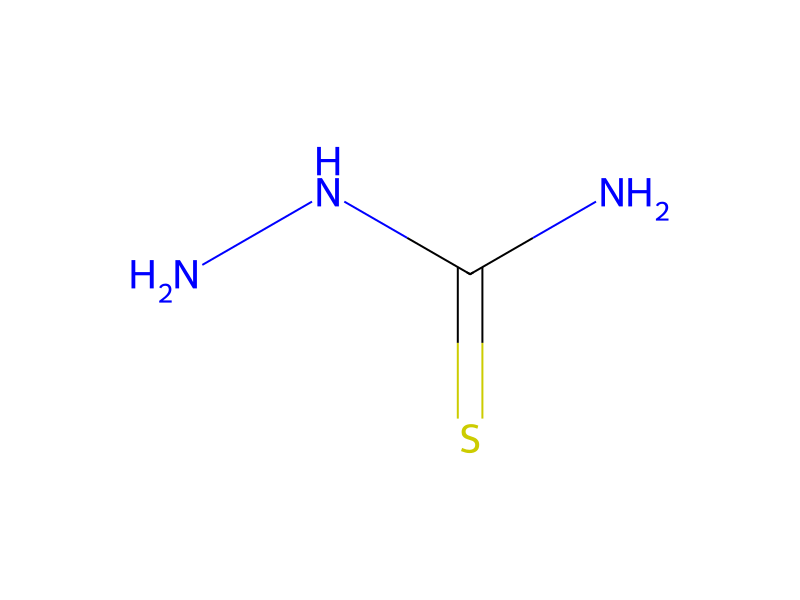

Produkt 2


Reagenzien, Katalysatoren, Lösungsmittel 1

Versuchsvorschrift
The key starting material 2-bromo-5-nitrothiazole was prepared by treating 2-amino-5-nitrothiazole (Aldrich) with sodium nitrite and hydrogen bromide (Fr. Demande 2,015,434, 1970). 3-Phenyl-1,2,4-triazole-5-thione (E. Hogarth, J. Chem. Soc. (1949) 1163) was prepared by first reacting benzoyl chloride with thiosemicarbazide in pyridine at 0° C. to give benzoyl thiosemicarbazide. Benzoyl thiosemicarbazide was treated with potassium hydroxide in ethanol to give 3-phenyl-1,2,4-triazole-5-thione. 3-Phenyl-1,2,4-triazole-5-thione (1.77 g) was then dissolved in 50 mL of methanol and treated with 0.57 g of 95% sodium methoxide, and then with 2-bromo-5-nitrothiazole (2.09 g). The mixture was stirred at room temperature for 2 hours and the precipitated sodium bromide was removed by filtration. The methanol was evaporated and the product crystallized from ethanol and water to give 1.5 g of 3-[(5-nitrothiazol-2-yl)mercapto]-5-phenyl-1,2,4-triazole, an orange solid.
Aufarbeitung
- customwas prepared
- customat 0° C.
Quellen und Nachweise
- ORD-Eintrag
- ord-193168dd07ee44a287ee147ca6e756ab
- Quelldatensatz
- uspto-grants-1999_03
- Patentnummer
- US05883110
Verknüpfte Notizen
Wird geladen…