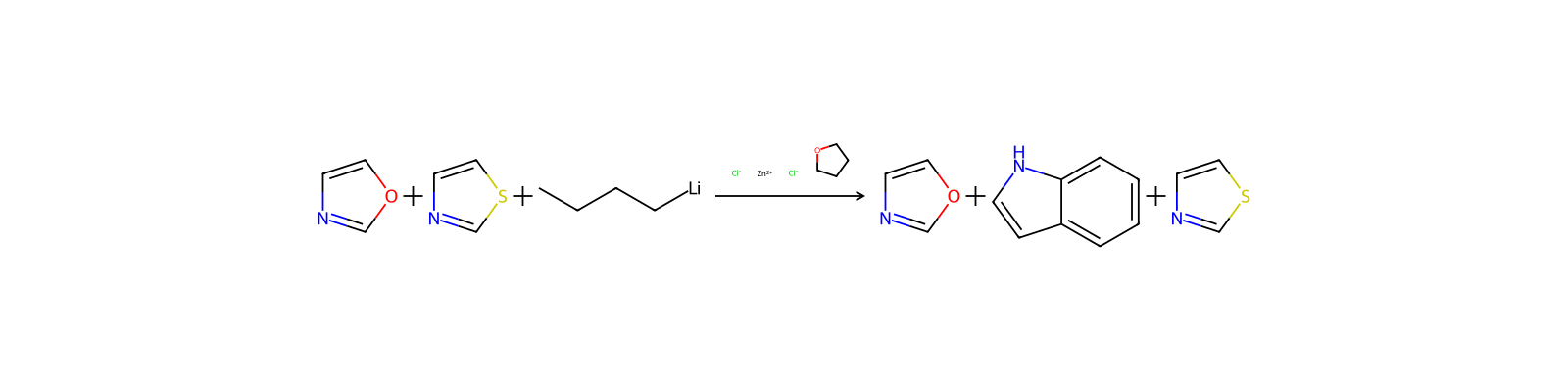
Beteiligte Stoffe
| Rolle | Name | HCID | Einwaage |
|---|
| Edukt | Oxazole | HCID 9255 | — |
| Edukt | Thiazole | HCID 9256 | — |
| Edukt | Butyllithium | HCID 178418339 | — |
| Katalysator | Zincchloride | HCID 3007855 | — |
| Lösungsmittel | Tetrahydrofuran | HCID 8028 | — |
| Produkt | Oxazole thiazole indole | HCID 86594208 | — |
Reaktionsschritte
Alternatively, iodo indole 5 is reacted with an alkyl halide, for example as propyl or butyl iodide, bromide, or chloride in the presence of a base, for example sodium hydride or potassium tert-butoxide, more preferably potassium tert-butoxide, in an organic solvent, for example THF, DMF or DMSO, preferably DMSO, at a temperature from room temperature to about 100° C., to yield iodo alkyl 9. An Oxazole or a thiazole in an organic solvent, for example dialkyl ether or THF, at a temperature from about 0 to about −78° C. is reacted with a base, preferably butyl lithium and optionally left stirring for from about 15 to about 60 min. Zinc chloride is then added and the mixture is allowed to warm to 0-30° C., at which time iodo alkyl 9 is added, followed by tetrakis triphenylphosphine palladium. The mixture is then optionally left stirring at a temperature from room temperature to about 80° C. to yield oxazole/thiazole indole 10.The hydrolysis of 10 by methods known to those skilled in the art yields oxazole/thiazole acid 11. Oxazole/thiazole acid 11 is coupled to amine (VIII) using methods known to those skilled in the art.
Herkunft & Nachweise
| DOI | 10.6084/m9.figshare.5104873.v1 |
|---|
| Patentnummer | US07727997B2 |
|---|
| Quelldatensatz | uspto-grants-2010_06 |
|---|
| ORD ID | ord-9347fa71c7034c56a09f02b9893039a7 |
|---|
| Quellennotiz | uspto-grants-2010_06 |
|---|