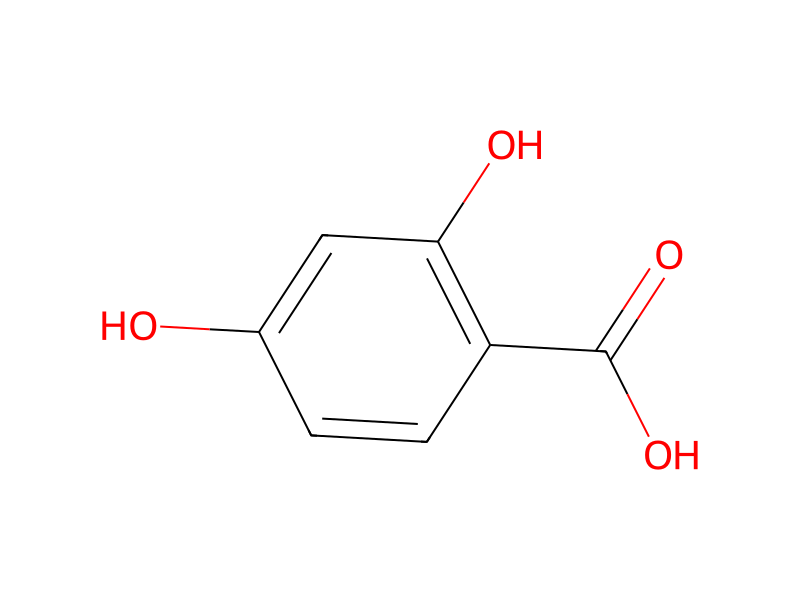
[OH:1][C:2]1[CH:10]=[C:9]([OH:11])[CH:8]=[CH:7][C:3]=1[C:4]([OH:6])=O.ON1C2C=CC=CC=2N=N1.C1(N=C=NC2CCCCC2)CCCCC1.[NH2:37][CH:38]1[CH2:42][N:41]([CH2:43][CH3:44])[N:40]([CH2:45][CH3:46])[CH2:39]1>C(Cl)(Cl)Cl>[CH2:45]([N:40]1[CH2:39][CH:38]([NH:37][C:4](=[O:6])[C:3]2[CH:7]=[CH:8][C:9]([OH:11])=[CH:10][C:2]=2[OH:1])[CH2:42][N:41]1[CH2:43][CH3:44])[CH3:46]To a solution of 2,4- dihydroxybenzoic acid (1.00 g) in tetrahydrofuran anhydride (20 ml) were added 1-hydroxybenzotriazole (1.05 g) and N,N'-dicyclohexyl carbodiimide (1.34 g) while being cooled with ice. After the resulting mixture was stirred for 30 minutes, 4-amino-1,2-diethylpyrazolidine (0.93 g) was added thereto and the mixture was stirred for one night at room temperature. The reaction solution, with chloroform added thereto, was washed with brine and then dried over sodium sulfate anhydride. The resulting organic layer was concentrated under a vacuum and thus formed residue was purified by silica gel column chromatography (chloroform: methanol=20:1) so as to yield 1.17 g (65%) of N-(1,2-diethyl-4-pyrazolidinyl)-2,4- dihydroxybenzamide.