Reaktionsgleichung
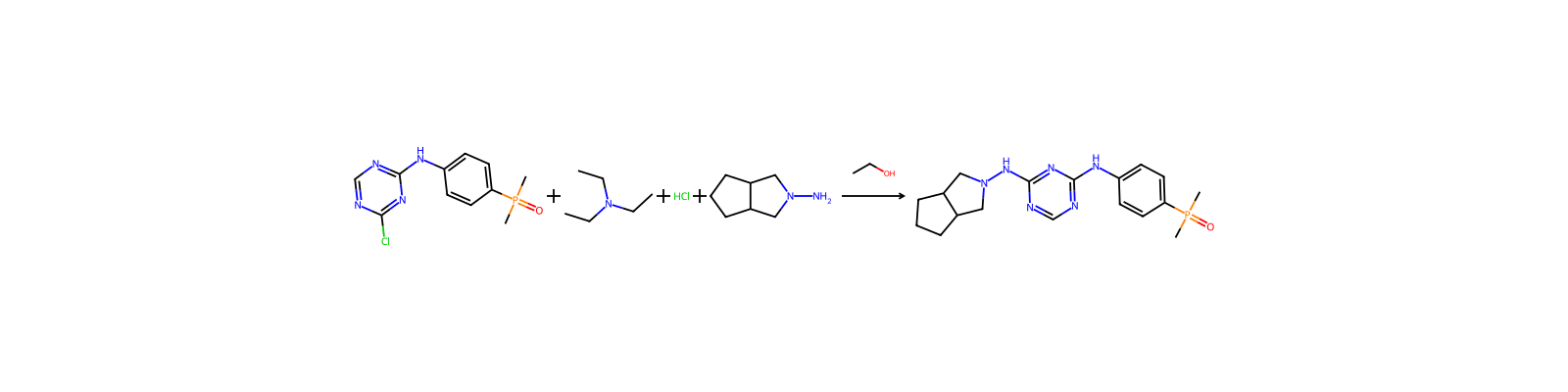
Cl[C:2]1[N:7]=[CH:6][N:5]=[C:4]([NH:8][C:9]2[CH:14]=[CH:13][C:12]([P:15]([CH3:18])([CH3:17])=[O:16])=[CH:11][CH:10]=2)[N:3]=1.C(N(CC)CC)C.Cl.[NH2:27][N:28]1[CH2:35][CH:34]2[CH:30]([CH2:31][CH2:32][CH2:33]2)[CH2:29]1>C(O)C>[CH3:17][P:15]([C:12]1[CH:13]=[CH:14][C:9]([NH:8][C:4]2[N:3]=[C:2]([NH:27][N:28]3[CH2:35][CH:34]4[CH2:33][CH2:32][CH2:31][CH:30]4[CH2:29]3)[N:7]=[CH:6][N:5]=2)=[CH:10][CH:11]=1)([CH3:18])=[O:16]Komponenten
5
Edukt 3



Produkt 1

Reagenzien, Katalysatoren, Lösungsmittel 1

Versuchsvorschrift
To a solution of 4-chloro-N-[4-(dimethylphosphoryl)phenyl]-1,3,5-triazin-2-amine (prepared as in Example 92: 0.12 mmol) in 2 mL of ethanol is added 50 μL of triethylamine and 3-Amino-3-azabicyclo-[3,3,0]octane hydrochloride salt (19 mg, 0.12 mmol). The mixture is microwaved at 120 degrees until formation of the desired compound. The reaction mixture is filtered through a syringe filter and purified by prep-HPLC.
Quellen und Nachweise
- ORD-Eintrag
- ord-24051f35e66b4af2afc59bc50d00ef37
- Quelldatensatz
- uspto-grants-2015_04
- Patentnummer
- US09012462B2
Verknüpfte Notizen
Wird geladen…