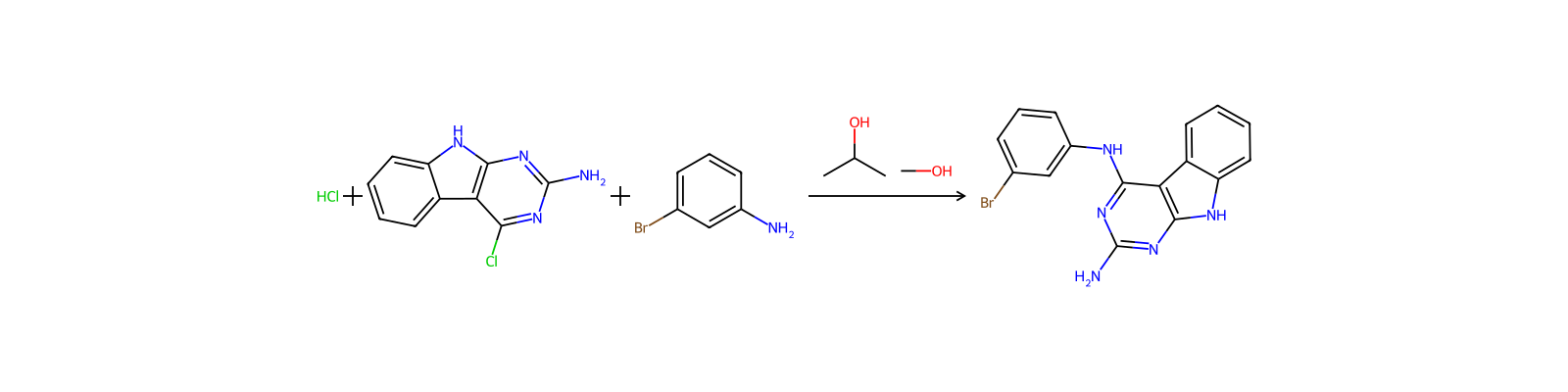
A mixture of 2-amino-4-chloroindolo[2,3-d]pyrimidine hydrochloride (123 mg, 0.6 mmol) and 3-bromoaniline (0.3 mL, 2.8 mmol) in 2-propanol (6 mL) is heated at reflux for 4 hr, filtered through a celite pad, and concentrated in vacuo. The residue is partitioned between ethyl acetate (25 mL) and water (25 mL). The aqueous phase is extracted with further ethyl acetate (2×20 mL), followed by washing the combined extracts with 1% aqueous sodium hydroxide (25 mL), water (2×40 mL), saturated brine (40 mL), and drying (Na2SO4). The solution is evaporated to dryness under reduced pressure to afford 105 mg crude product as a tan powder. The solid is dissolved in a minimum amount of methanol, filtered, and further purified by preparative plate chromatography (SiO2 ; 1:1, EtOAc: CH2Cl2 ; Rf =0.40 ). After extraction of the product from the silica gel with ethyl acetate, the volume of the warm solution is reduced to minimum, and it is filtered through celite, and the solvent is removed under reduced pressure. The oily solid thus obtained is dissolved in a minimum amount of 2-propanol and allowed to crystallize at 3 C. over an 18 h period. The crystals are collected by suction filtration, washed with a small amount of cold 2-propanol, and dried in vacuo to give 2-amino-4-(3-bromoanilino) indolo[2,3-d]pyrimidine (34 mg, 17%). 1 HNMR, (DMSO): δbrs), 8.57 (1H, s), 8.11 (1H, d, J =8.0 Hz), 8.01 (1H, s), 7.94 (1H, d, J=8.2 Hz), 7.34-7.12 (5H, m), 6.41 (2H, brs).