StartseiteMCPWorkbenchSkills
StartseiteWorkbenchBenachrichtigungenMein Bereich
llms.txt · MCP-AnleitungDatenschutz · Nutzungsbedingungen · Supportv1.8.3
  1. Startseite
  2. /Reaktion

1,4-Dibromobenzene → 2-(2,5-Dibromophenyl)-4,4,5,5-tetramethyl-1,3,2-dioxaborolane

HRID 1490569
Drucken

Reaktionsgleichung

Reaktionsgleichung von HRID 1490569
Brc1ccc(Br)cc1>C1=CCCC=CCC1.C1=CCCC=CCC1.CC1(C)OB(B2OC(C)(C)C(C)(C)O2)OC1(C)C.COC1CCCC1.C[OH2+].C[OH2+].[Ir].[Ir].c1ccc(N2B(B3Nc4ccccc4N3c3ccccn3)Nc3ccccc32)nc1>CC1(C)OB(c2cc(Br)ccc2Br)OC1(C)C
KomponentenReaktionsbedingungenVersuchsvorschriftQuellen und NachweiseNotizen zur Reaktion

Komponenten

6

Edukt 1

HCID 78041,4-Dibromobenzene

Produkt 1

HCID 707006522-(2,5-Dibromophenyl)-4,4,5,5-tetramethyl-1,3,2-dioxaborolaneAusbeute 62 %

Reagenzien, Katalysatoren, Lösungsmittel 4

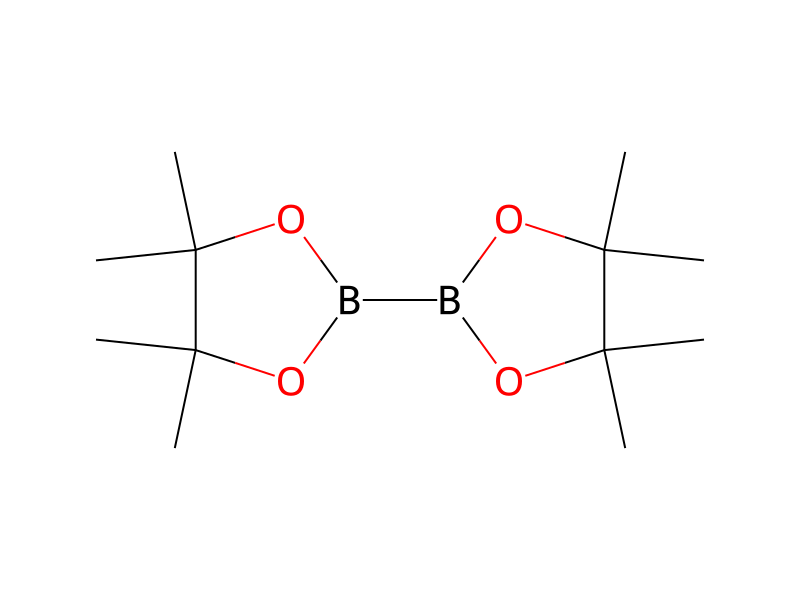
HCID 2733548Bis(pinacolato)diboraneReagenzHCID 1223807993-pyridin-2-yl-2-(3-pyridin-2-yl-1H-1,3,2-benzodiazaborol-2-yl)-1H-1,3,2-benzodiazaboroleReagenz
HCID 76001521
Bis(1,5-cyclooctadiene)dimethoxydiiridium
Katalysator
HCID 138539Cyclopentyl methyl etherLösungsmittel

Reaktionsbedingungen

Temperatur
100 °C

Versuchsvorschrift

The general procedure A was followed using 1,4-dibromobenzene (118.0 mg, 0.5 mmol) and B2pin2 (126.9 mg, 0.5 mmol, 1.0 eq.) as starting material. The resulting mixture was allowed to stir 16 hours at 100 oC. The 1H NMR conversion was 90% and the byproducts were 2,6-di- and 2,5-di- borylated products. The 1H NMR yields of 5ac, 2,6-di- and 2,5-di- borylated products were 67%, 12% and 12% respectively. 5ac was obtained as white solid (112.0 mg, 62%) after purification by silica gel flash chromatography (EtOAc/PE=1:100 v/v). m.p.: 54-56 oC.

Quellen und Nachweise

ORD-Eintrag
ord-066c508c5a254808b5bb566fd4b02a47
Quelldatensatz
Borylation dataset from Roche
DOI
10.1021/jacs.5b05252

Notizen zur Reaktion

Auf dieser SeiteKomponentenReaktionsbedingungenVersuchsvorschriftQuellen und NachweiseNotizen zur Reaktion