Triethylamine → 4-Bromoquinoline-2-carboxylic acid
Reaktionsgleichung

[Br:1][C:2]1[C:11]2[C:6](=[CH:7][CH:8]=[CH:9][CH:10]=2)[N:5]=[C:4]([C:12]([OH:14])=[O:13])[CH:3]=1.[NH2:15][C@@H:16]1[C@@H:21]([OH:22])[CH2:20][CH2:19][O:18][CH2:17]1.CN([P+](ON1N=NC2C=CC=CC1=2)(N(C)C)N(C)C)C.F[P-](F)(F)(F)(F)F.C(N(CC)CC)C>C(Cl)Cl>[Br:1][C:2]1[C:11]2[C:6](=[CH:7][CH:8]=[CH:9][CH:10]=2)[N:5]=[C:4]([C:12]([OH:14])=[O:13])[CH:3]=1.[Br:1][C:2]1[C:11]2[C:6](=[CH:7][CH:8]=[CH:9][CH:10]=2)[N:5]=[C:4]([C:12]([NH:15][C@@H:16]2[C@@H:21]([OH:22])[CH2:20][CH2:19][O:18][CH2:17]2)=[O:14])[CH:3]=1Komponenten
7
Edukt 4

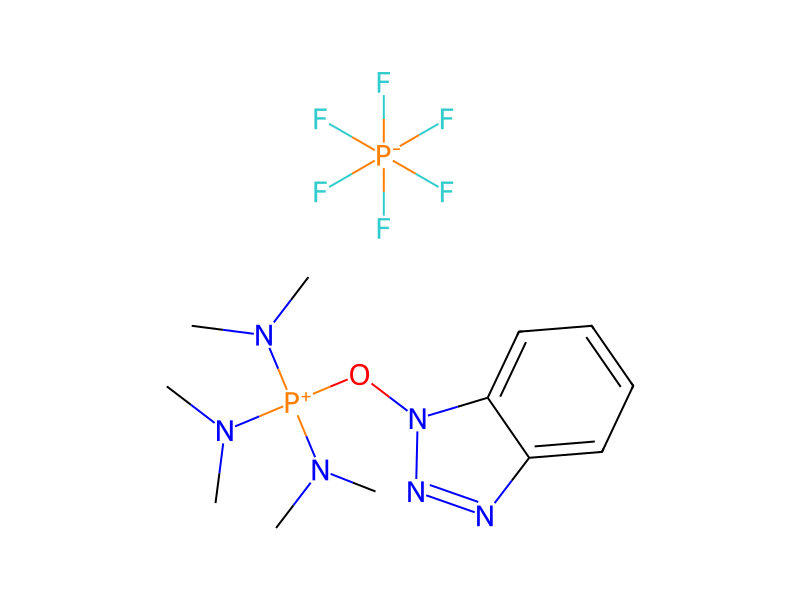


Produkt 2

Reagenzien, Katalysatoren, Lösungsmittel 1

Versuchsvorschrift
4-Bromoquinoline-2-carboxylic acid (A3) was prepared as described in Example 1. To a solution of A3 (0.35 g, 1.4 mmol) in 6.0 mL CH2Cl2 was added (3S,4S)-3-aminotetrahydro-2H-pyran-4-ol (0.20 g, 1.7 mmol), BOP reagent (0.74 g, 1.7 mmol), and triethylamine (0.58 mL, 4.2 mmol). The reaction mixture was stirred at room temperature for 16 h, diluted with CH2Cl2, washed with water, dried over sodium sulfate, filtered, and concentrated. The resultant residue was subjected to silica gel chromatography eluting with 25-100% ethyl acetate in hexanes to afford 4-bromo-N-[(3S,4S)-4-hydroxytetrahydro-2H-pyran-3-yl]quinoline-2-carboxamide that gave a mass ion (ES+) of 353.1 (81Br) for M+H+.
Aufarbeitung
- washwashed with water
- dry with materialdried over sodium sulfate
- filtrationfiltered
- concentrationconcentrated
- washeluting with 25-100% ethyl acetate in hexanes
Quellen und Nachweise
- ORD-Eintrag
- ord-43e1082865624560852b0899dbf4a344
- Quelldatensatz
- uspto-grants-2015_12
- Patentnummer
- US09199939B2
Notizen zur Reaktion
Wird geladen…