Reaktionsgleichung
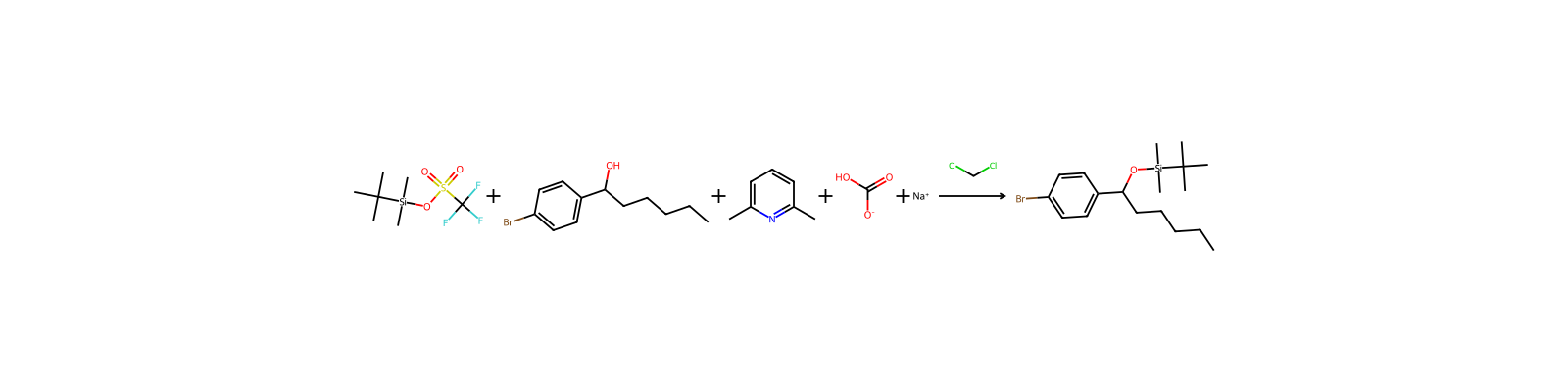
[Si:1]([O:8]S(C(F)(F)F)(=O)=O)([C:4]([CH3:7])([CH3:6])[CH3:5])([CH3:3])[CH3:2].[Br:16][C:17]1[CH:22]=[CH:21][C:20]([CH:23](O)[CH2:24][CH2:25][CH2:26][CH2:27][CH3:28])=[CH:19][CH:18]=1.N1C(C)=CC=CC=1C.C(=O)(O)[O-].[Na+]>ClCCl>[Br:16][C:17]1[CH:22]=[CH:21][C:20]([CH:23]([O:8][Si:1]([C:4]([CH3:7])([CH3:6])[CH3:5])([CH3:3])[CH3:2])[CH2:24][CH2:25][CH2:26][CH2:27][CH3:28])=[CH:19][CH:18]=1Komponenten
6
Edukt 4




Produkt 1

Reagenzien, Katalysatoren, Lösungsmittel 1

Versuchsvorschrift
TBSOTf (2.9 mL, 12.6 mmol) was added to an ice-cold solution of 4 (3.017 g, 11.7 mmol) and 2,6-lutidine (1.6 mL, 13.7 mmol) in dichloromethane (30 mL). The reaction was stirred for 2 h at room temperature and then 100 mL saturated sodium bicarbonate solution was added. The resulting mixture was extracted with dichloromethane (30 mL) and the dichloromethane layer was washed with 1 M HCl (2×50 mL) and brine (50 mL). The dichloromethane solution was then dried (MgSO4), filtered and evaporated. Purification of the residue by flash chromatography on silica gel (hexanes) gave compound 5 (3.843 g, 88%).
Aufarbeitung
- extractionThe resulting mixture was extracted with dichloromethane (30 mL)
- washthe dichloromethane layer was washed with 1 M HCl (2×50 mL) and brine (50 mL)
- dry with materialThe dichloromethane solution was then dried (MgSO4)
- filtrationfiltered
- customevaporated
- customPurification of the residue by flash chromatography on silica gel (hexanes)
Quellen und Nachweise
- ORD-Eintrag
- ord-57b752c626fb4e7bb2cebf81a4fdcceb
- Quelldatensatz
- uspto-grants-2010_06
- Patentnummer
- US07732443B2
Verknüpfte Notizen
Wird geladen…