StartseiteMCPWorkbenchSkills
StartseiteWorkbenchBenachrichtigungenMein Bereich
llms.txt · MCP-AnleitungDatenschutz · Nutzungsbedingungen · Supportv1.8.3
  1. Startseite
  2. /Reaktion

Potassium Carbonate → 2-(4-Cyclopropyl-3-oxo-1-oxa-4,9-diazaspiro[5.5]undecan-9-yl)-2-(4-(quinolin-7-yl)phenyl)acetic acid

HRID 1525850
Drucken

Reaktionsgleichung

Reaktionsgleichung von HRID 1525850
Br[C:2]1[CH:7]=[CH:6][C:5]([CH:8]([N:12]2[CH2:26][CH2:25][C:15]3([O:20][CH2:19][C:18](=[O:21])[N:17]([CH:22]4[CH2:24][CH2:23]4)[CH2:16]3)[CH2:14][CH2:13]2)[C:9]([OH:11])=[O:10])=[CH:4][CH:3]=1.CC1(C)C(C)(C)OB([C:35]2[CH:44]=[C:43]3[C:38]([CH:39]=[CH:40][CH:41]=[N:42]3)=[CH:37][CH:36]=2)O1.C(=O)([O-])[O-].[K+].[K+]>O1CCOCC1.C(O)C.C1C=CC(P(C2C=CC=CC=2)[C-]2C=CC=C2)=CC=1.C1C=CC(P(C2C=CC=CC=2)[C-]2C=CC=C2)=CC=1.Cl[Pd]Cl.[Fe+2].C(Cl)Cl>[CH:22]1([N:17]2[CH2:16][C:15]3([CH2:25][CH2:26][N:12]([CH:8]([C:5]4[CH:6]=[CH:7][C:2]([C:35]5[CH:44]=[C:43]6[C:38]([CH:39]=[CH:40][CH:41]=[N:42]6)=[CH:37][CH:36]=5)=[CH:3][CH:4]=4)[C:9]([OH:11])=[O:10])[CH2:13][CH2:14]3)[O:20][CH2:19][C:18]2=[O:21])[CH2:24][CH2:23]1
KomponentenVersuchsvorschriftAufarbeitungQuellen und NachweiseNotizen zur Reaktion

Komponenten

7

Edukt 3

HCID 11430Potassium CarbonateHCID 592961167-(4,4,5,5-tetramethyl-1,3,2-dioxaborolan-2-yl)QuinolineHCID 712707412-(4-Bromophenyl)-2-(4-cyclopropyl-3-oxo-1-oxa-4,9-diazaspiro[5.5]undecan-9-yl)acetic acid

Produkt 1

HCID 712708152-(4-Cyclopropyl-3-oxo-1-oxa-4,9-diazaspiro[5.5]undecan-9-yl)-2-(4-(quinolin-7-yl)phenyl)acetic acidAusbeute 32 %

Reagenzien, Katalysatoren, Lösungsmittel 3

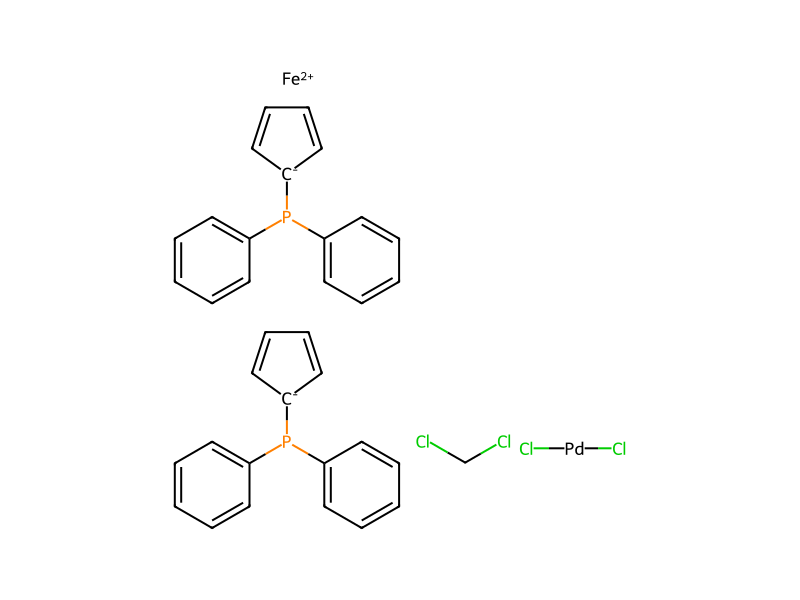
HCID 178418807HCID 178418807, VerbindungKatalysatorHCID 702EthanolLösungsmittelHCID 312751,4-DioxaneLösungsmittel

Versuchsvorschrift

A solution of 2-(4-bromophenyl)-2-(4-cyclopropyl-3-oxo-1-oxa-4,9-diazaspiro[5.5]undecan-9-yl)acetic acid (0.402 mmol) in 1,4-dioxane (2 mL) and ethanol (0.2 mL) was treated with 7-(4,4,5,5-tetramethyl-1,3,2-dioxaborolan-2-yl)quinoline (0.442 mmol), PdCl2(dppf)-CH2Cl2 adduct (0.020 mmol) and 2M aq potassium carbonate (0.602 mL). The vessel was purged with nitrogen, sealed and the reaction irradiated in a Biotage Initiator microwave at 120° C. for 10 min. The resulting black solution was then diluted with water (50 mL) and brine (10 mL), and the aqueous solution was sequentially extracted with dichloromethane and tetrahydrofuran. Only the tetrahydrofuran layer contained the product. The aqueous layer was concentrated in vacuo and the resulting solid was triturated with ethanol. The ethanol solution was filtered and added to the tetrahydrofuran layer. This organic phase was dried over sodium sulfate, filtered and concentrated in vacuo. Purification of the crude material by reverse phase HPLC (10-35% acetonitrile/water with 0.1% NH4OH) afforded the title compound as a white solid (32%). MS(ES)+ m/e 472.4 [M+H]+.

Aufarbeitung

  1. customThe vessel was purged with nitrogen
  2. customsealed
  3. customthe reaction irradiated in a Biotage Initiator microwave at 120° C. for 10 min
  4. additionThe resulting black solution was then diluted with water (50 mL) and brine (10 mL)
  5. extractionthe aqueous solution was sequentially extracted with dichloromethane and tetrahydrofuran
  6. concentrationThe aqueous layer was concentrated in vacuo
  7. customthe resulting solid was triturated with ethanol
  8. filtrationThe ethanol solution was filtered
  9. additionadded to the tetrahydrofuran layer
  10. dry with materialThis organic phase was dried over sodium sulfate
  11. filtrationfiltered
  12. concentrationconcentrated in vacuo
  13. customPurification of the crude material by reverse phase HPLC (10-35% acetonitrile/water with 0.1% NH4OH)

Quellen und Nachweise

ORD-Eintrag
ord-2b94df34ebba4328984377325d529749
Quelldatensatz
uspto-grants-2015_07
DOI
10.6084/m9.figshare.5104873.v1
Patentnummer
US09084794B2

Notizen zur Reaktion

Auf dieser SeiteKomponentenVersuchsvorschriftAufarbeitungQuellen und NachweiseNotizen zur Reaktion