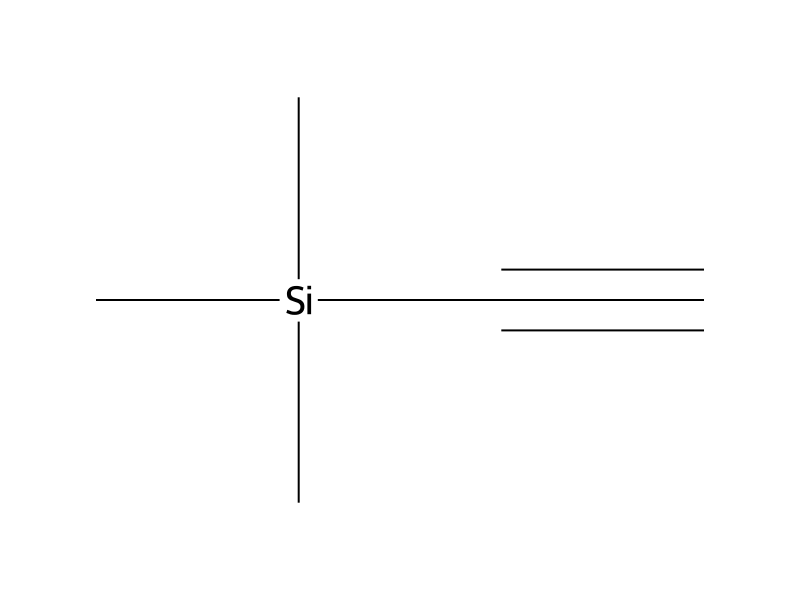
[CH3:1][C:2]1([CH3:20])[C:11]2[C:6](=[CH:7][C:8](Br)=[CH:9][CH:10]=2)[N:5]([C:13]2[CH:18]=[CH:17][C:16]([CH3:19])=[CH:15][CH:14]=2)[CH2:4][CH2:3]1.C(N(CC)CC)C.[CH3:28][Si:29]([C:32]#[CH:33])([CH3:31])[CH3:30]>[Cu]I.Cl[Pd](Cl)([P](C1C=CC=CC=1)(C1C=CC=CC=1)C1C=CC=CC=1)[P](C1C=CC=CC=1)(C1C=CC=CC=1)C1C=CC=CC=1.C(Cl)Cl>[CH3:1][C:2]1([CH3:20])[C:11]2[C:6](=[CH:7][C:8]([C:33]#[C:32][Si:29]([CH3:31])([CH3:30])[CH3:28])=[CH:9][CH:10]=2)[N:5]([C:13]2[CH:18]=[CH:17][C:16]([CH3:19])=[CH:15][CH:14]=2)[CH2:4][CH2:3]1To a solution of 0.20 g (0.6 mmol) of 4,4-dimethyl-1,2,3,4-tetrahydro-N-(4-methylphenyl)-7-bromoquinoline (Compound 1) in 2.90 g (4.0 mL, 29 mmol) of triethylamine were added 0.030 g (0.16 mmol) of copper(I) iodide, 0.35 g (0.50 mL, 3.5 mmol) of (trimethylsilyl)acetylene and 0.074 g (0.11 mmol) of bis(triphenylphosphine)palladium(II) chloride. The resulting mixture was heated at 75° C. for 20 hours. The reaction mixture was cooled, methylene chloride was added and the mixture was adsorbed onto silica gel. The mixture was separated by flash chromatography (hexanes) to give the title compound as a yellow solid. PNMR (300 MHz, CDCl,) d 0.20 (9 H, s), 1.35 (6 H, s), 1.84 (2 H, t, J=6.0 Hz), 2.39 (3 H, s), 3.59 (2 H, t, J=6.0 Hz), 6.78 (1 H, d, J=1.7 Hz), 6.84 (1 H, rid, J=7.8,1.7 Hz), 7.12-7.17 (5 H, several overlapping d's).