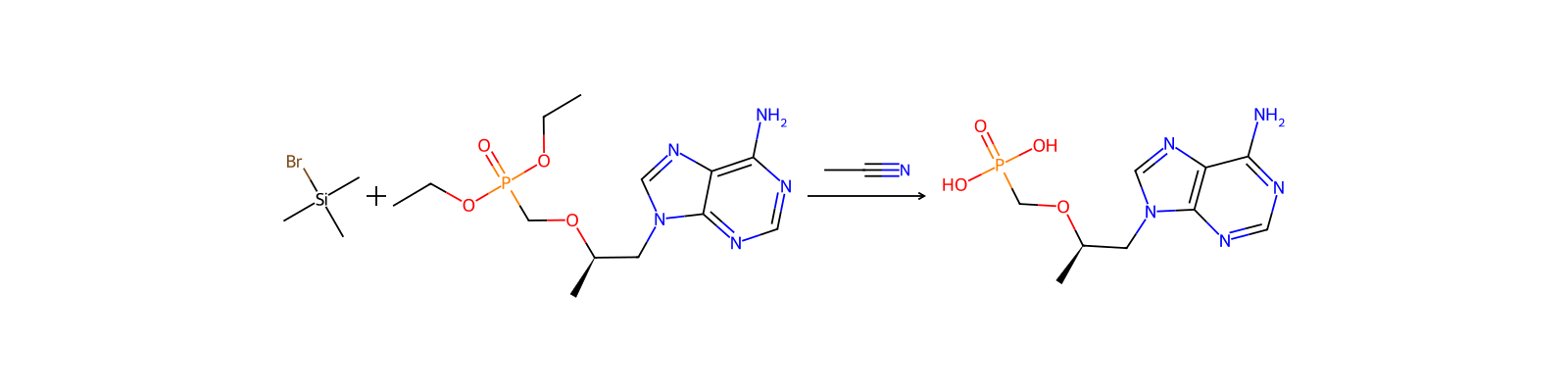
Beteiligte Stoffe
| Rolle | Name | HCID | Einwaage |
|---|
| Edukt | Bromotrimethylsilane | HCID 76113 | — |
| Edukt | Diethyl P-(((1R)-2-(6-amino-9H-purin-9-yl)-1-methylethoxy)methyl)phosphonate | HCID 10947889 | — |
| Lösungsmittel | Acetonitrile | HCID 6342 | — |
| Produkt | Tenofovir | HCID 464205 | 100% |
Reaktionsschritte
Bromotrimethylsilane (1.56 kg) is added to a reactor containing a mixture of crude (R)-9-[2-(diethylphosphonomethoxy)propyl]adenine (1.0 kg calculated based on adenine input from step 4 above) and acetonitrile (0.9 kg) with cooling to maintain a temperature no higher than about 50° C. The lines are rinsed forward with acetonitrile (0.3 kg) and the mixture is refluxed at about 60-75° C. for about 2-4 hours with moderate agitation to avoid splashing the reactor contents. Reaction completion is monitored by area normalized HPLC showing no more than about 3% total of monoethyl PMPA and diethyl PMPA remaining. If the reaction is incomplete, additional bromotrimethylsilane (0.04 kg) is charged into the reactor and the reaction is refluxed for at least about 1 hour with moderate agitation. The volatiles are removed by distillation at no higher than about 70° C. initially at atmospheric pressure and then in vacuo (about 24-27 in Hg) at no higher than about 70° C. The reactor is then cooled to about 20° C. (typically about 15-25° C.) and water (1.9 kg) is added (exothermic addition) to the residue with the temperature maintained at no higher than about 50° C. The mixture is cooled to 20° C. and washed with dichloromethane (1.7 kg) by agitating for about 30 minutes. The isolated aqueous phase is then filtered through a 1 μm cartridge filter, diluted with water (3.2 kg), heated to about 40° C. (typically about 35-50° C.) and adjusted to pH about 1.1 (typically about 0.9-1.3) with aqueous sodium hydroxide about 0.15 kg NaOH as a 50% solution) while the temperature is maintained at about 45° C. PMPA seed crystals are added to the mixture and the pH is adjusted to about 2.8 (typically about 2.6-3.0) with a 50% aqueous sodium hydroxide solution (about 0.15 kg NaOH required) while the temperature is maintained at about 45° C. (typically about 35-50° C.). The solution is cooled to about 22° C. (typically about 15-25° C.) over about 3-20 hours with slow to moderate agitation that avoids splashing the contents, during which time the product should precipitate, beginning at about 35° C. The pH of the slurry is adjusted to about 3.2 (typically about 3.1-3.3), usually using 50% aqueous sodium hydroxide or concentrated hydrochloric acid, if necessary. The slurry is cooled to approximately 5° C., typically about 0-10° C., and slowly agitated for at least about 3 hours in that temperature range. The solids are collected by filtration, washed sequentially with cold water (0.35 kg) and acetone (0.3 kg) giving crude PMPA as a damp solid typically of about 97% purity. The product is heated to about 50° C. and dried in vacuo to a water content of less than 10%. The quantity of diethyl PMPA is calculated from the quantity of adenine used in the preceding step of the synthesis (assuming 100% yield) and not from the net weight of the crude diethyl PMPA, which may contain other compounds.
Herkunft & Nachweise
| DOI | 10.6084/m9.figshare.5104873.v1 |
|---|
| Patentnummer | US05977089 |
|---|
| Quelldatensatz | uspto-grants-1999_11 |
|---|
| ORD ID | ord-58200576814443c3a332df715699a0cf |
|---|
| Quellennotiz | uspto-grants-1999_11 |
|---|