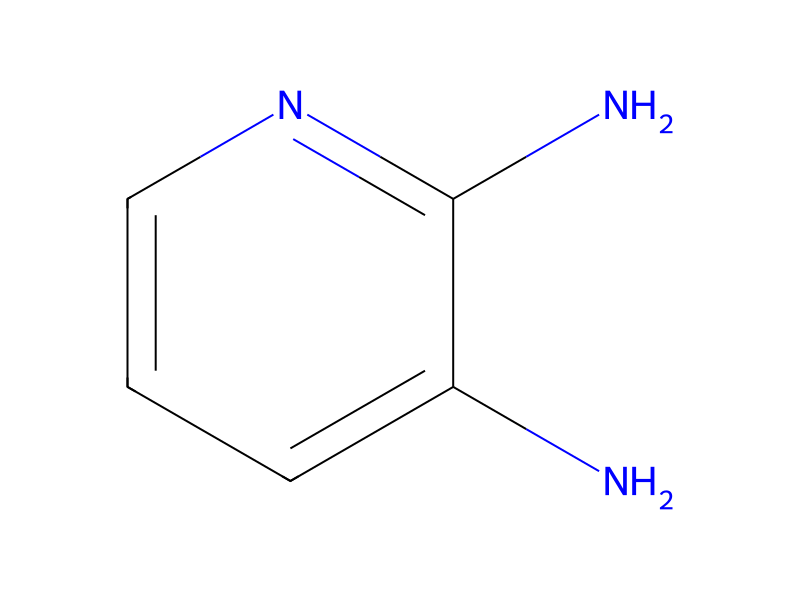
N-(Benzyloxycarbonyl)sarcosine (4.1 g, 18.5 mmol) was dissolved in dry THF, and triethylamine (3 mL, 21.6 mmol) was added, followed by isobutylchloroformate (2.5 mL, 19.27 mmol). The solution was cooled to about -20° C. for 15 minutes, then a solution of 2,3-diaminopyridine (2.0767 g, 19.03 mmol) in dry THF was added slowly. The reaction was kept stirring between -10° C. to -20° C. for 15 minutes, then was allowed to warm to RT. After 3 d, the reaction was evaporated under vacuum, and the residue was partitioned between EtOAc and 1N NaHCO3. The EtOAc phase was dried (MgSO4) and evaporated under vacuum. The residue was dissolved in glacial AcOH and was stirred in a oil bath at 70° C. After 24 h, the reaction was removed from the oil bath, allowed to cool to RT, and concentrated under vacuum. The residue was evaporated with toluene, then was chromatographed on silica gel (CHCl3, then 3% MeOH/CHCl3, then 5% MeOH/CHCl3) to afford the title compound (1.13 g, 19%): 1H NMR (250 MHz, CDCl3) δ 3.05 (s, 3H), 3.99 (s, 2H), 4.82 (br s, 1H), 6.5-6.65 (m, 1H), 7.32 (s, 5H), 7.87 (d, 1H), 8.84 (br s, 1H); MS (ES) m/e 315.4 (M+H)+.