Reaktionsgleichung

O=P12OP3(OP(OP(O3)(O1)=O)(=O)O2)=O.[NH:15]([C:22]1[CH:30]=[C:29]([C:31](O)=[O:32])[C:28]([NH:34][C:35]2[CH:40]=[CH:39][CH:38]=[CH:37][CH:36]=2)=[CH:27][C:23]=1[C:24](O)=[O:25])[C:16]1[CH:21]=[CH:20][CH:19]=[CH:18][CH:17]=1.ClC1C=CC=CC=1NC1C=C(C(O)=O)C(NC2C=CC=CC=2Cl)=CC=1C(O)=O>>[CH:38]1[CH:39]=[C:40]2[C:31]([C:29]3[C:28]([NH:34][C:35]2=[CH:36][CH:37]=1)=[CH:27][C:23]1[C:24]([C:21]2[C:16]([NH:15][C:22]=1[CH:30]=3)=[CH:17][CH:18]=[CH:19][CH:20]=2)=[O:25])=[O:32]Komponenten


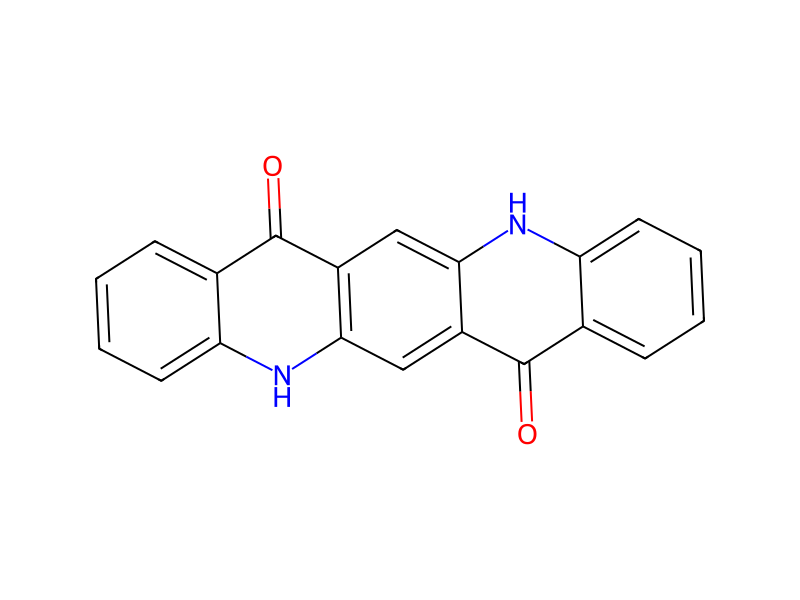
Reaktionsbedingungen
- Temperatur
- 85 °C
Versuchsvorschrift
380 parts of polyphosphoric acid, containing 85.0% P2O5, are introduced into a pressure vessel. Then 68.5 parts of 2,5-dianilinoterephthalic acid and 7.6 parts of 2,5-di(2-chloro-anilino)terephthalic acid are introduced with stirring at from 80 to 90° C. and the mixture is heated at 125° C. for 1 hour during which ring closure takes place to form the quinacridone. The reaction mixture is then introduced into a second pressure vessel where it is hydrolyzed under pressure and with stirring with a mixture of 1711 parts of 30% phosphoric acid at 140° C. During this hydrolysis the temperature rises to 155° C. The mixture is stirred at 155° C. for 0.5 hour. Then it is cooled to 60° C. and the mixed crystal pigment is filtered off with suction, washed to neutrality with water and dried at 80° C.
Aufarbeitung
- additionare introduced into a pressure vessel
- temperaturethe mixture is heated at 125° C. for 1 hour during which ring closure
Quellen und Nachweise
- ORD-Eintrag
- ord-1b761a76018241538b4ee43d015030e5
- Quelldatensatz
- uspto-grants-1999_11
- Patentnummer
- US05989333
Verknüpfte Notizen
Wird geladen…