Reaktionsgleichung
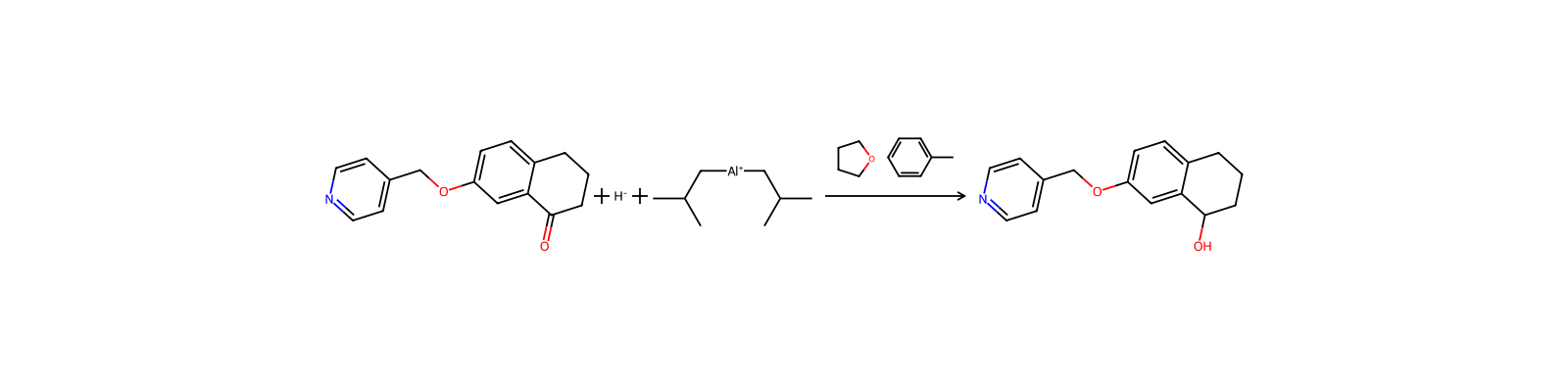
[N:1]1[CH:6]=[CH:5][C:4]([CH2:7][O:8][C:9]2[CH:18]=[C:17]3[C:12]([CH2:13][CH2:14][CH2:15][C:16]3=[O:19])=[CH:11][CH:10]=2)=[CH:3][CH:2]=1.[H-].C([Al+]CC(C)C)C(C)C>O1CCCC1.C1(C)C=CC=CC=1>[N:1]1[CH:6]=[CH:5][C:4]([CH2:7][O:8][C:9]2[CH:18]=[C:17]3[C:12]([CH2:13][CH2:14][CH2:15][CH:16]3[OH:19])=[CH:11][CH:10]=2)=[CH:3][CH:2]=1Komponenten
5
Edukt 2


Produkt 1

Reagenzien, Katalysatoren, Lösungsmittel 2


Versuchsvorschrift
To a solution of Compound 1 (16.41 g, 64.9 mmol) in tetrahydrofuran (75 mL) at 0° C. was added dropwise a 1M solution of diisobutylaluminum hydride in toluene (97.3 mL). After 1 hr, the reaction was quenched with aqueous potassium sodium tartrate and diluted with ethyl acetate followed by warming to room temperature. After stirring for an additional hour, the layers were separated and the aqueous phase was re-extracted with ethyl acetate (2×). The extracts were combined, washed with brine, dried over anhydrous magnesium sulfate, filtered and concentrated in vacuo. Chromatography of the residue on silica gel (elution with ethyl acetate) provided 12.96 g of Compound 2 as an oil which crystallized upon standing.
Aufarbeitung
- customthe reaction was quenched with aqueous potassium sodium tartrate
- additiondiluted with ethyl acetate
- customthe layers were separated
- extractionthe aqueous phase was re-extracted with ethyl acetate (2×)
- washwashed with brine
- dry with materialdried over anhydrous magnesium sulfate
- filtrationfiltered
- concentrationconcentrated in vacuo
Quellen und Nachweise
- ORD-Eintrag
- ord-b57a278ca83a40158214026646782b72
- Quelldatensatz
- uspto-grants-1998_03
- Patentnummer
- US05726184
Verknüpfte Notizen
Wird geladen…