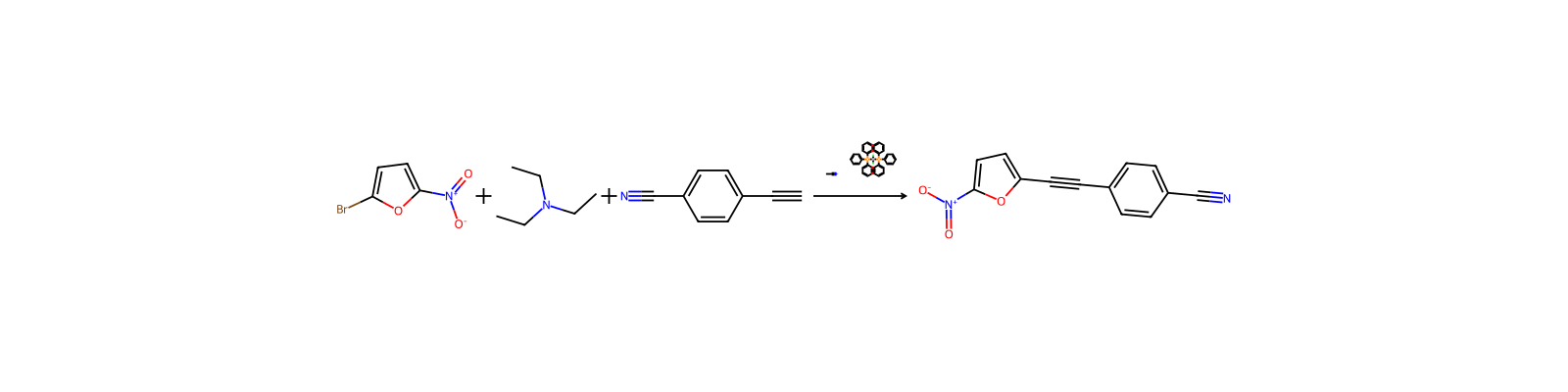
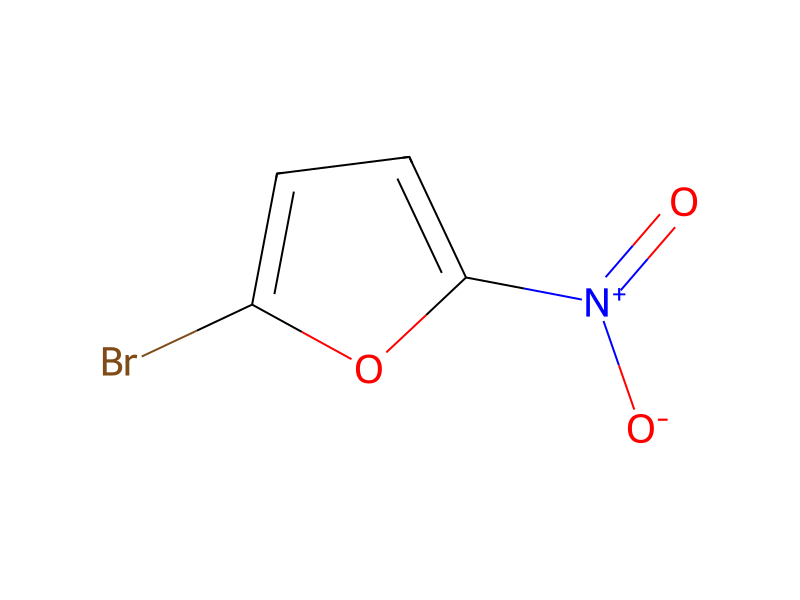
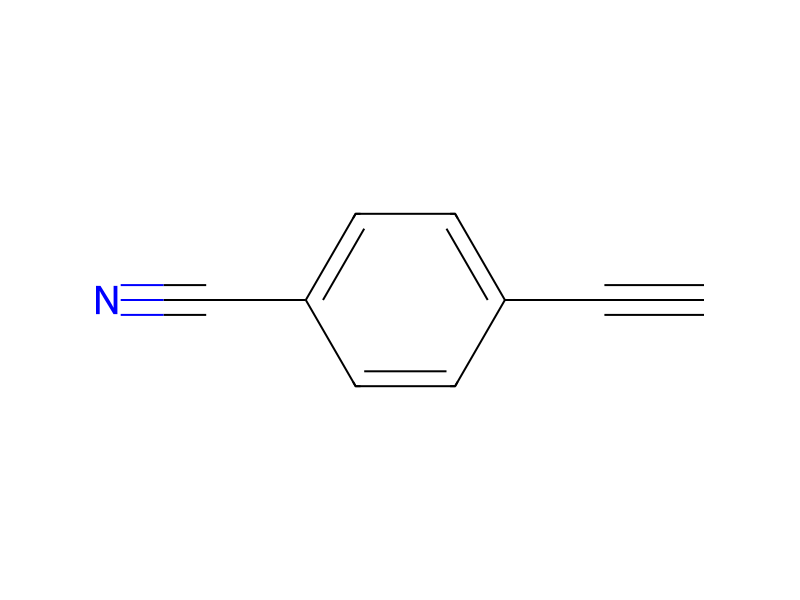
Br[C:2]1[O:3][C:4]([N+:7]([O-:9])=[O:8])=[CH:5][CH:6]=1.C(N(CC)CC)C.[C:17]([C:19]1[CH:26]=[CH:25][C:22]([C:23]#[N:24])=[CH:21][CH:20]=1)#[CH:18]>C(#N)C.Cl[Pd](Cl)([P](C1C=CC=CC=1)(C1C=CC=CC=1)C1C=CC=CC=1)[P](C1C=CC=CC=1)(C1C=CC=CC=1)C1C=CC=CC=1>[N+:7]([C:4]1[O:3][C:2]([C:18]#[C:17][C:19]2[CH:26]=[CH:25][C:22]([C:23]#[N:24])=[CH:21][CH:20]=2)=[CH:6][CH:5]=1)([O-:9])=[O:8]To a solution of 2-bromo-5-nitrofuran (1.65 g) and triethylamine (34 ml) in anhydrous acetonitrile (55 ml) under nitrogen was added bis(triphenylphosphine)palladium dichloride (130 mg) and cuprous iodide (35 mg). 4-Ethynylbenzonitrile (1.09 g) was added and the reaction mixture was stirred under nitrogen overnight. The mixture was evaporated to dryness and the residue was dissolved in dichloromethane (200 ml), dried over anhydrous sodium sulfate, filtered and evaporated to dryness. The residue was purified by silica gel chromatography (ethyl acetate/hexane 1:10) and triturated with ethyl acetate/hexane (1:3) to give 4-[(5-nitro-2-furyl)-ethynyl]benzonitrile.
Wird geladen…