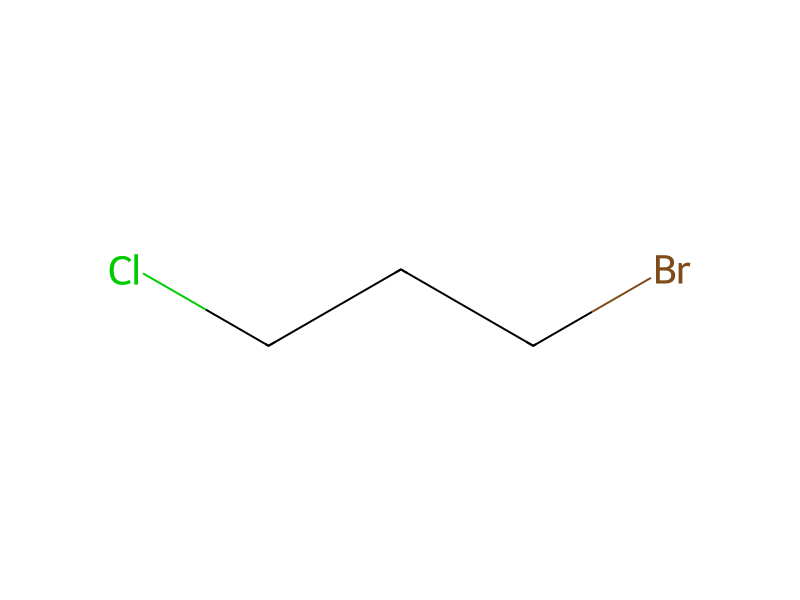
[F:1][C:2]1[CH:7]=[CH:6][C:5]([CH:8]([C:10]2[CH:11]=[N:12][CH:13]=[CH:14][CH:15]=2)[OH:9])=[CH:4][CH:3]=1.[OH-].[Na+].Br[CH2:19][CH2:20][CH2:21][Cl:22]>[Cl-].C([N+](CC)(CC)CC1C=CC=CC=1)C.CC1C=CC=CC=1>[Cl:22][CH2:21][CH2:20][CH2:19][O:9][CH:8]([C:5]1[CH:4]=[CH:3][C:2]([F:1])=[CH:7][CH:6]=1)[C:10]1[CH:11]=[N:12][CH:13]=[CH:14][CH:15]=1.[ClH:22].[Cl:22][CH2:21][CH2:20][CH2:19][O:9][CH:8]([C:5]1[CH:4]=[CH:3][C:2]([F:1])=[CH:7][CH:6]=1)[C:10]1[CH:11]=[N:12][CH:13]=[CH:14][CH:15]=1To a stirred and heated (50° C.) mixture of 15 parts of α-(4-fluorophenyl)-3-pyridinemethanol, 3.4 parts of N,N,N-triethylbenzenemethanaminium chloride, 50 parts of a sodium hydroxide solution 50% and 135 parts of methylbenzene were added dropwise 10 parts of 1-bromo-3-chloropropane. Upon complete addition, stirring was continued for 4 hours. Another portion of 5 parts of 1-bromo-3-chloropropane were added and the whole was stirred for 4 hours at 50° C. After cooling to room temperature, the reaction mixture was poured into ice water and the product was extracted twice with methylbenzene. The combined extracts were washed with a sodium carbonate solution, dried, filtered and evaporated. The excess of 1-bromo-3-chloropropane was distilled off at on oil pump. The residue was purified by column chromatography over silica gel using a mixture of trichloromethane and methanol, saturated with ammonia, (97:3 by volume) as eluent. The pure fractions were collected and the eluent was evaporated, yielding 6 parts (34.3 %) of a mixture of 55% of 3-[(3-chloropropoxy)(4-fluorophenyl)methyl]pyridine and 45% of 3-[(3-chloropropoxy)(4-fluorophenyl)methyl]pyridine monohydrochloride as a residue (int. 64).