Reaktionsgleichung

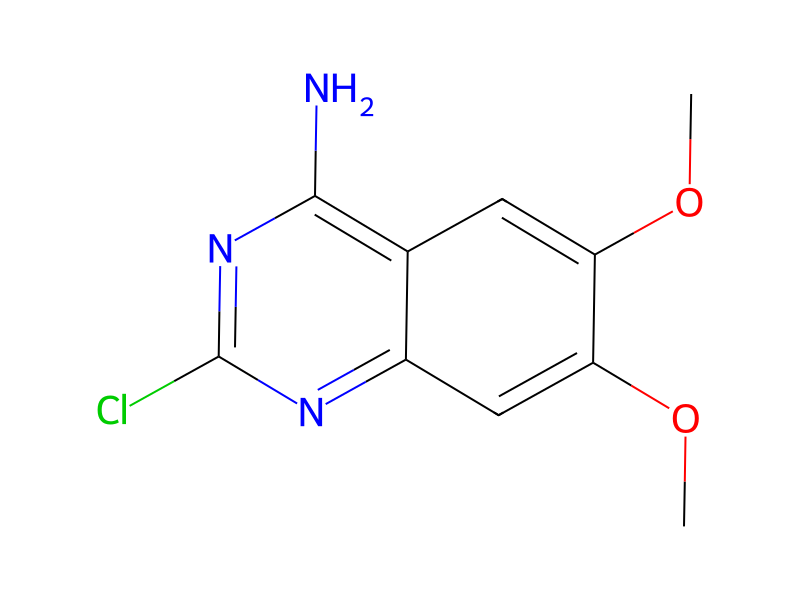
[Cl:1][C:2]1[N:11]=[C:10]([NH2:12])[C:9]2[C:4](=[CH:5][C:6]([O:15][CH3:16])=[C:7]([O:13][CH3:14])[CH:8]=2)[N:3]=1.[O:17]1[CH2:21][CH2:20][CH2:19][CH:18]1[C:22]([N:24]1[CH2:29][CH2:28][NH:27][CH2:26][CH2:25]1)=[O:23]>COC(O)C>[ClH:1].[O:17]1[CH2:21][CH2:20][CH2:19][CH:18]1[C:22]([N:24]1[CH2:25][CH2:26][N:27]([C:2]2[N:11]=[C:10]([NH2:12])[C:9]3[C:4](=[CH:5][C:6]([O:15][CH3:16])=[C:7]([O:13][CH3:14])[CH:8]=3)[N:3]=2)[CH2:28][CH2:29]1)=[O:23]Komponenten
4
Edukt 2

Produkt 1

Reagenzien, Katalysatoren, Lösungsmittel 1

Versuchsvorschrift
To 7.00 g 2-chloro-4-amino-6,7-dimethoxyquinazoline (Lancaster Synthesis) in 50 ml methoxyethanol was added 10.8 g, tetrahydrofuroylpiperazine, and the mixture refluxed 3 hours. The clear solution was concentrated and an aqueous solution of potassium bicarbonate was added. The resultant solid that formed was filtered and washed with water. It was then added to methanol and the resulting suspension was acidified with a solution of hydrogen chloride in isopropyl alcohol. The resulting solution was concentrated and the residue crystallized from isopropyl alcohol giving 8.12 g. of product, m.p. 278°-279° C.
Aufarbeitung
- temperaturethe mixture refluxed 3 hours
- concentrationThe clear solution was concentrated
- additionan aqueous solution of potassium bicarbonate was added
- customThe resultant solid that formed
- filtrationwas filtered
- washwashed with water
- additionIt was then added to methanol
- concentrationThe resulting solution was concentrated
- customthe residue crystallized from isopropyl alcohol giving 8.12 g
Quellen und Nachweise
- ORD-Eintrag
- ord-0e41a6faa1c04f1c9c0eadce49ddc28e
- Quelldatensatz
- uspto-grants-1995_04
- Patentnummer
- US05403847
Verknüpfte Notizen
Wird geladen…