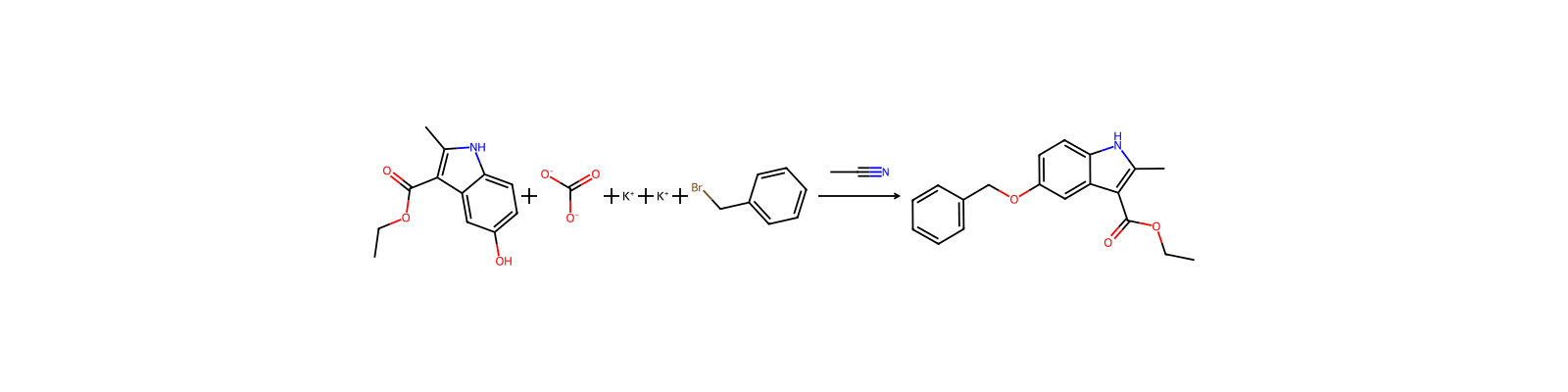
[OH:1][C:2]1[CH:3]=[C:4]2[C:8](=[CH:9][CH:10]=1)[NH:7][C:6]([CH3:11])=[C:5]2[C:12]([O:14][CH2:15][CH3:16])=[O:13].C(=O)([O-])[O-].[K+].[K+].[CH2:23](Br)[C:24]1[CH:29]=[CH:28][CH:27]=[CH:26][CH:25]=1>C(#N)C>[CH2:23]([O:1][C:2]1[CH:3]=[C:4]2[C:8](=[CH:9][CH:10]=1)[NH:7][C:6]([CH3:11])=[C:5]2[C:12]([O:14][CH2:15][CH3:16])=[O:13])[C:24]1[CH:29]=[CH:28][CH:27]=[CH:26][CH:25]=1To a mixture of 5-hydroxy-2-methyl-1H-indole-3-carboxylic acid, ethyl ester (0.76 g, 3.47 mmol) and potassium carbonate (0.92 g, 6.67 mmol) in acetonitrile (10 ml) was added benzyl bromide (1.0 ml, 1.4 g, 8.4 mmol). The mixture was heated at 75-80° C. for 18 h. The reaction was cooled to room temperature, quenched with water, extracted with EtOAc, washed with brine, dried over Na2SO4, and concentrated under reduced pressure. The residue was purified by flash column chromatography on silica gel (30% EtOAc-hexanes) to yield 5-benzyloxy-2-methyl-1H-indole-3-carboxylic acid, ethyl ester (Compound 53) as a yellow solid (0.56 g, 52%).