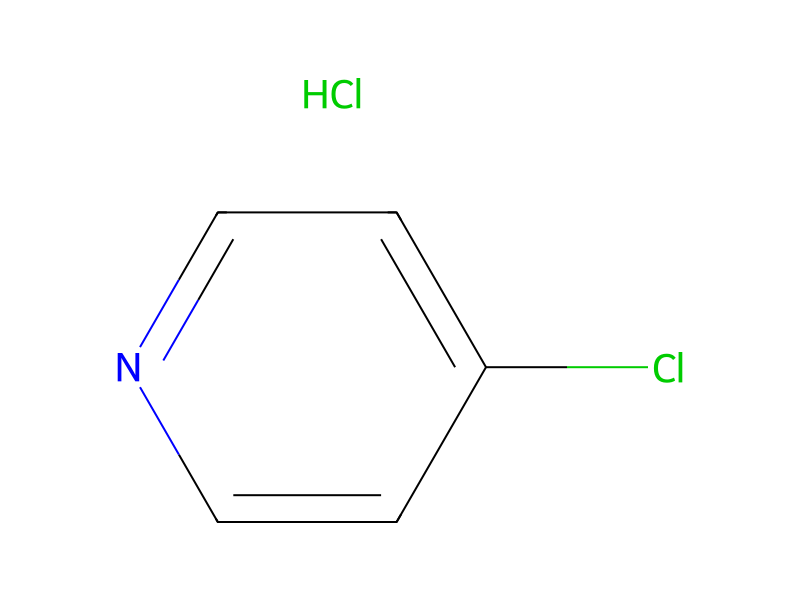
The reaction was performed under an N2 atmosphere. tert-Butyl 2,8-diazaspiro[4.5]decane-8-carboxylate (869 mg, 3.62 mmol), 4-chloropyridine hydrochloride (1.08 g, 7.20 mmol) and TEA (2.5 ml, 18 mmol) were suspended in isopropanol (10 ml). The mixture was heated to 80° C. and stirred overnight at 80° C. Then the solvent was removed in a rotary evaporator. The residue was taken up in DCM and concentrated to small volume again. This process was repeated twice more. The crude product was purified by column chromatography (silica gel, DCM/7M NH3 in MeOH, 98:2). The product obtained still contained impurities and was used in the next stage in that condition. 2. The reaction was performed under an N2 atmosphere. The carbamate (1.034 g, max. 3.26 mmol) was dissolved in MeOH (5 ml) and mixed with 4 M HCl in dioxane (5 ml). The reaction batch was stirred for 2 h at RT. Then the solvent was removed. The crude product was purified by column chromatography (silica gel, DCM/7M NH3 in MeOH, 98:2→95:5→9:1). Yield: 455 mg, 58% over 2 stages.