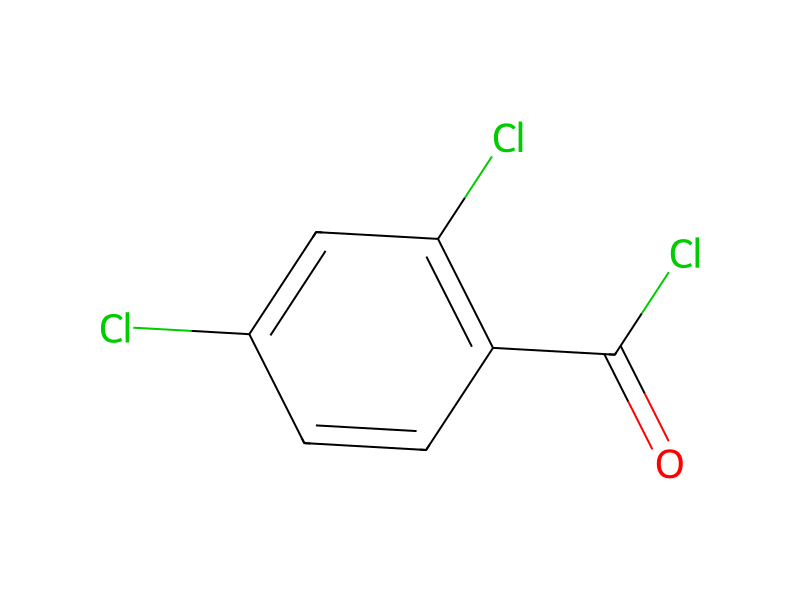
CC(S([NH:7][CH:8]([C:11]1[CH:16]=[CH:15][C:14]([S:17]([CH2:20][CH2:21][CH3:22])(=[O:19])=[O:18])=[CH:13][CH:12]=1)[CH:9]=[CH2:10])=O)(C)C.Cl.C(N(CC)CC)C.[Cl:31][C:32]1[CH:40]=[C:39]([Cl:41])[CH:38]=[CH:37][C:33]=1[C:34](Cl)=[O:35]>CO>[Cl:31][C:32]1[CH:40]=[C:39]([Cl:41])[CH:38]=[CH:37][C:33]=1[C:34]([NH:7][CH:8]([C:11]1[CH:12]=[CH:13][C:14]([S:17]([CH2:20][CH2:21][CH3:22])(=[O:18])=[O:19])=[CH:15][CH:16]=1)[CH:9]=[CH2:10])=[O:35]2-Methyl-N-{1-[4-(propylsulphonyl)phenyl]prop-2-en-1-yl}propane-2-sulphinamide (213 mg, 0.62 mmol) was dissolved in methanol. Methanolic hydrogen chloride was added and the reaction mixture was stirred at room temperature for 2 h. Following concentration in vacuo the residue was suspended in dichloromethane and stirred under nitrogen. Triethylamine (0.173 mL, 1.24 mmol) was added followed by 2,4-dichlorobenzoyl chloride (87 μL, 0.62 mmol) and the reaction mixture was stirred overnight. The reaction was quenched by addition of water and satd. NaHCO3(aq). The product was extracted into ethyl acetate (×2) and then the combined organic layers washed with brine, dried (MgSO4) and concentrated. 1H NMR 5 (400 MHz, CDCl3) δ 0.99 (3H, t, J=7.4 Hz), 1.66-1.76 (2H, m), 3.00-3.04 (2H, m), 5.30-5.37 (2H, m), 5.86 (1H, t, J=6.9 Hz), 6.02-6.10 (1H, m), 7.19 (1H, d, J=7.9 Hz), 7.29 (1H, dd, J=8.5, 2.1 Hz), 7.40 (1H, d, J=1.9 Hz), 7.56 (2H, dd, J=8.3, 2.5 Hz), 7.83 (2H, d, J=8.3 Hz).
Wird geladen…