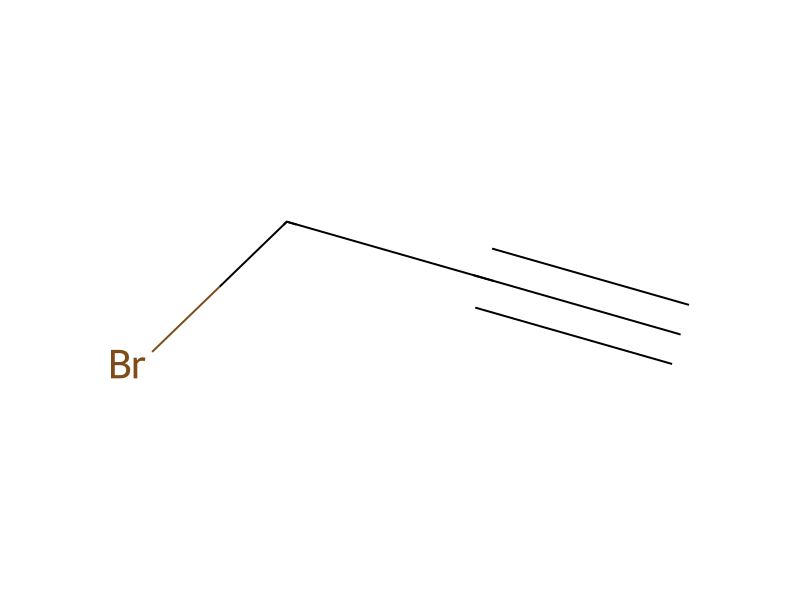
[H-].[Na+].[Cl:3][C:4]1[CH:5]=[C:6]([CH:10]=[C:11]([O:17][CH2:18][C:19]#[CH:20])[C:12]=1[O:13][CH2:14][C:15]#[CH:16])[C:7]([OH:9])=[O:8].[CH2:21](Br)[C:22]#[CH:23]>CN(C)C=O>[Cl:3][C:4]1[CH:5]=[C:6]([CH:10]=[C:11]([O:17][CH2:18][C:19]#[CH:20])[C:12]=1[O:13][CH2:14][C:15]#[CH:16])[C:7]([O:9][CH2:23][C:22]#[CH:21])=[O:8]Sodium hydride (0.23 g; 60% dispersion in mineral oil) was added to a solution of 3-chloro-4,5-dipropargyloxybenzoic acid (1.50 g) in N,N-dimethylformamide (50 ml) at 0° C., followed by stirring at room temperature for 1 hour. Propargyl bromide (0.80 g) was added thereto, and the resultant mixture was stirred at 90° C. for 5 minutes, poured into ice-water and extracted with ethyl acetate. The extract was washed with an aqueous potassium carbonate solution, dried over magnesium sulfate and concentrated under reduced pressure. The residue was subjected to silica gel chromatography using toluene as an eluent to give propargyl 3-chloro-4,5-dipropargyloxybenzoate (1.03 g). m.p. 98°-99° C.