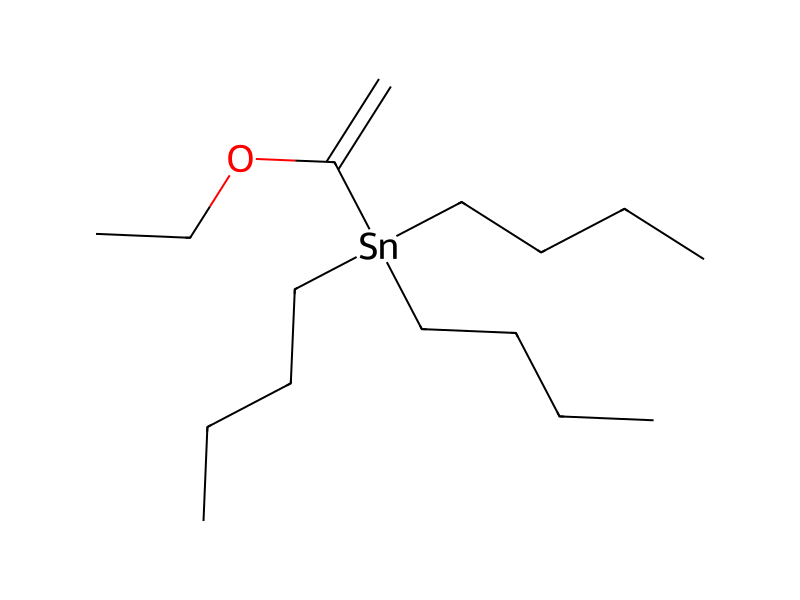
Br[C:2]1[CH:3]=[C:4]([NH:8][C:9](=[O:11])[CH3:10])[CH:5]=[N:6][CH:7]=1.C([Sn](CCCC)(CCCC)[C:17]([O:19][CH2:20][CH3:21])=[CH2:18])CCC>CN(C=O)C.[F-].[K+].Cl[Pd](Cl)([P](C1C=CC=CC=1)(C1C=CC=CC=1)C1C=CC=CC=1)[P](C1C=CC=CC=1)(C1C=CC=CC=1)C1C=CC=CC=1>[CH2:20]([O:19][C:17]([C:2]1[CH:3]=[C:4]([NH:8][C:9](=[O:11])[CH3:10])[CH:5]=[N:6][CH:7]=1)=[CH2:18])[CH3:21]To a solution of N-(5-bromopyridin-3-yl)acetamide (2.7 mmol) and Pd(PPh3)2Cl2 (0.13 mmol) in DMF (5 mL) under an atmosphere of nitrogen was added tributyl(1-ethoxyvinyl)stannane (2.97 mmol). The reaction was allowed to stir at 80° C. until for approximately 24 hrs. The reaction mixture was allowed to cool to rt and then diluted with aq KF solution (10 mL) and allowed to stir for 30 min. A thick white precipitate formed and was filtered. The filter cake was washed with water and Et2O. The filtrate was diluted with water and extracted with Et2O. The organic solutions were combined, dried over Na2SO4, filtered, and concentrated. The residue was purified by column chromatography to give N-[5-(1-ethoxyvinyl)pyridin-3-yl]acetamide in quantitative yield. LCMS: (FA) ES+ 205.2.