8-Quinolinamine, 6-bromo- → 5-Acetyl-4-[(6-bromoquinolin-8-yl)amino]-2-ethyl-6-phenylpyridazin-3(2H)-one
Reaktionsgleichung

[C:1]([C:4]1[C:9]([C:10]2[CH:15]=[CH:14][CH:13]=[CH:12][CH:11]=2)=[N:8][N:7]([CH2:16][CH3:17])[C:6](=[O:18])[C:5]=1[N+:19]([O-])=O)(=[O:3])[CH3:2].N[C:23]1[CH:24]=[C:25]([Br:33])[CH:26]=[C:27]2[C:32]=1[N:31]=[CH:30][CH:29]=[CH:28]2>C(O)C>[C:1]([C:4]1[C:9]([C:10]2[CH:15]=[CH:14][CH:13]=[CH:12][CH:11]=2)=[N:8][N:7]([CH2:16][CH3:17])[C:6](=[O:18])[C:5]=1[NH:19][C:23]1[CH:24]=[C:25]([Br:33])[CH:26]=[C:27]2[C:32]=1[N:31]=[CH:30][CH:29]=[CH:28]2)(=[O:3])[CH3:2]Komponenten
4
Edukt 2

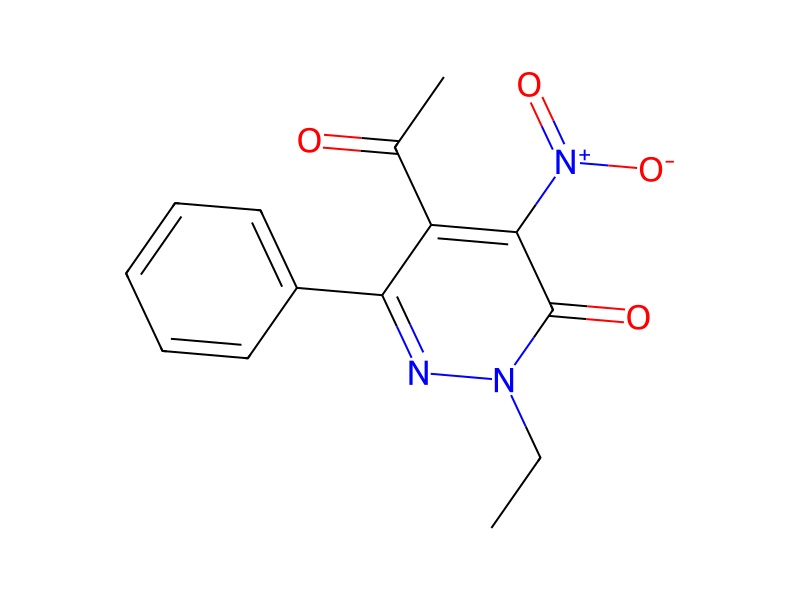
Produkt 1

Reagenzien, Katalysatoren, Lösungsmittel 1

Versuchsvorschrift
To a stirred solution of 80 mg (0.279 mmol) of 5-acetyl-2-ethyl-4-nitro-6-phenylpyridazin-3(2H)-one (Dal Piaz, V et al, J. Med. Chem. 1997, 40, 1417) in ethanol (4 mL), 8-amino-6-bromoquinoline (93 mg, 0.417 mmol) was added. The resulting mixture was stirred at room temperature or one day. The solvent was evaporated and the residue purified by column chromatography (silica gel, hexane/ethyl acetate 3:1) to yield the title compound (110 mg, 85.3% yield).