Hydrochloric Acid → L-Tryptophan monohydrochloride
HRID 1728910
Reaktionsgleichung

[NH2:1][C@H:2]([C:13]([OH:15])=[O:14])[CH2:3][C:4]1[C:12]2[C:7](=[CH:8][CH:9]=[CH:10][CH:11]=2)[NH:6][CH:5]=1.[ClH:16].[Cl-].[Na+]>>[ClH:16].[NH2:1][C@H:2]([C:13]([OH:15])=[O:14])[CH2:3][C:4]1[C:12]2[C:7](=[CH:8][CH:9]=[CH:10][CH:11]=2)[NH:6][CH:5]=1Komponenten
4


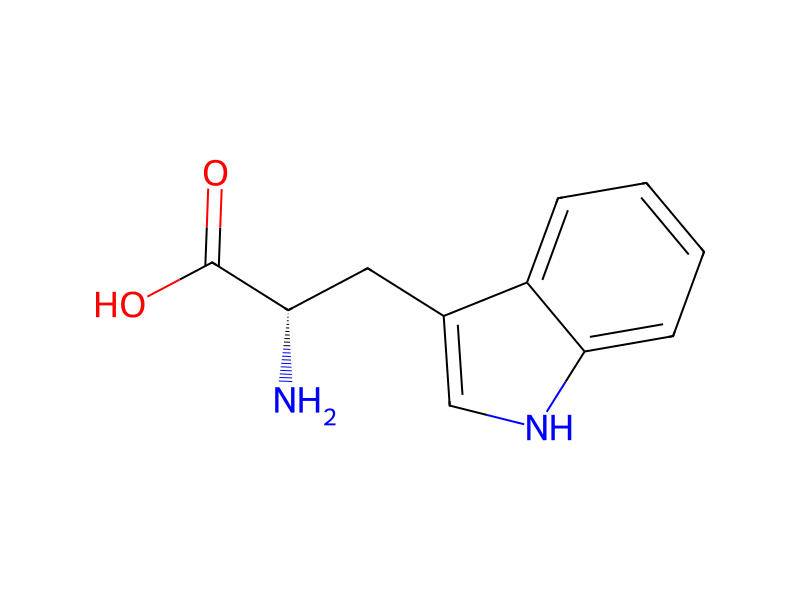

Reaktionsbedingungen
- Temperatur
- 15 °C
Versuchsvorschrift
The pH of 30 l of L-tryptophan fermentation broth was adjusted to 3.5 with 35% hydrochloric acid. After the cells were removed from the broth by centrifugation, the solution was concentrated at a temperature of 60° C. under reduced pressure, until the concentration of L-tryptophan reached 180 g/l. Next, 3.5 equivalents of 35% hydrochloride acid and 3 equivalents of sodium chloride (both relative to the amount of L-tryptophan) were added to the slurry, while keeping the concentrated slurry at 50° C. After cooling to 15° C. overnight, the crystals were separated with a centrifuging machine, and were washed with water. The crystals were dried at 60° C. for 2 hours under reduced pressure to give 156 g of L-tryptophan hydrochloride crystals. The L-tryptophan hydrochloride crystals thus obtained had a purity of 95.7%.