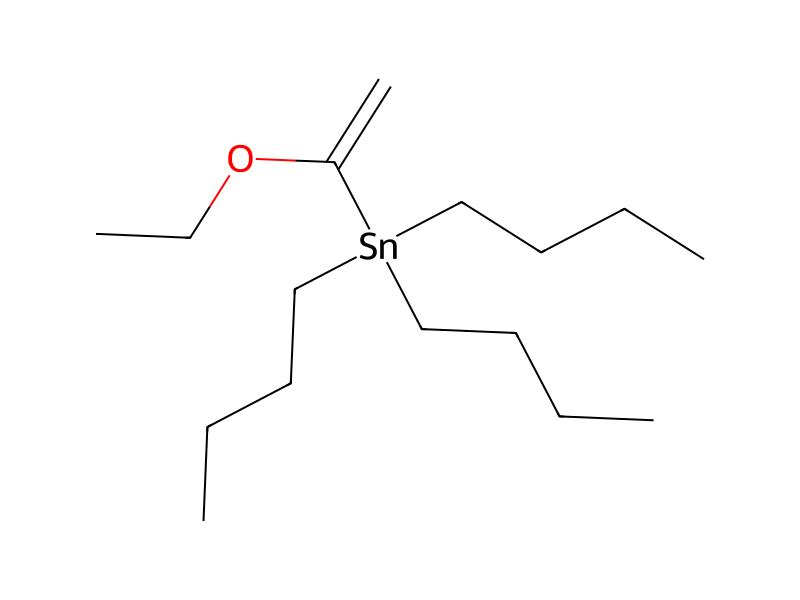
Stannane, tributyl(1-ethoxyethenyl)- → 6-(1-Ethoxyvinyl)-2-(dimethylamino)-7-fluoro-5-methyl-1,3-benzoxazole-4-carbonitrile
Reaktionsgleichung

Br[C:2]1[C:3]([F:17])=[C:4]2[O:8][C:7]([N:9]([CH3:11])[CH3:10])=[N:6][C:5]2=[C:12]([C:15]#[N:16])[C:13]=1[CH3:14].C([Sn](CCCC)(CCCC)[C:23]([O:25][CH2:26][CH3:27])=[CH2:24])CCC>C1(C)C=CC=CC=1.Cl[Pd](Cl)([P](C1C=CC=CC=1)(C1C=CC=CC=1)C1C=CC=CC=1)[P](C1C=CC=CC=1)(C1C=CC=CC=1)C1C=CC=CC=1.C(C1(C)C(O)=C(C(C)(C)C)C=CC1)(C)(C)C>[CH2:26]([O:25][C:23]([C:2]1[C:3]([F:17])=[C:4]2[O:8][C:7]([N:9]([CH3:11])[CH3:10])=[N:6][C:5]2=[C:12]([C:15]#[N:16])[C:13]=1[CH3:14])=[CH2:24])[CH3:27]Komponenten
6