StartseiteMCPWorkbenchSkills
StartseiteWorkbenchBenachrichtigungenMein Bereich
llms.txt · MCP-AnleitungDatenschutz · Nutzungsbedingungen · Supportv1.8.0
  1. Startseite
  2. /Reaktion

Triethylamine → 2-Cyclopropyl-7-[(3S)-3-(dimethylamino)pyrrolidin-1-yl]-6-(2-methoxy-1,3-thiazole-4-yl)-5-methyl-1,3-benzoxazole-4-carbonitrile

HRID 17457
Notizen
Druckvorschau

Reaktionsgleichung

Reaktionsgleichung von HRID 17457
[CH:1]1([C:4]2[O:5][C:6]3[C:7](=[C:9]([C:22]#[N:23])[C:10]([CH3:21])=[C:11]([C:14]4[N:15]=[C:16]([O:19][CH3:20])[S:17][CH:18]=4)[C:12]=3F)[N:8]=2)[CH2:3][CH2:2]1.C(N(CC)CC)C.[CH3:31][N:32]([CH3:38])[C@H:33]1[CH2:37][CH2:36][NH:35][CH2:34]1.C(=O)([O-])O.[Na+]>CS(C)=O.C(OCC)(=O)C>[CH:1]1([C:4]2[O:5][C:6]3[C:7](=[C:9]([C:22]#[N:23])[C:10]([CH3:21])=[C:11]([C:14]4[N:15]=[C:16]([O:19][CH3:20])[S:17][CH:18]=4)[C:12]=3[N:35]3[CH2:36][CH2:37][C@H:33]([N:32]([CH3:38])[CH3:31])[CH2:34]3)[N:8]=2)[CH2:3][CH2:2]1
KomponentenReaktionsbedingungenVersuchsvorschriftAufarbeitungQuellen und NachweiseNotizen zur Reaktion

Komponenten

7

Edukt 4

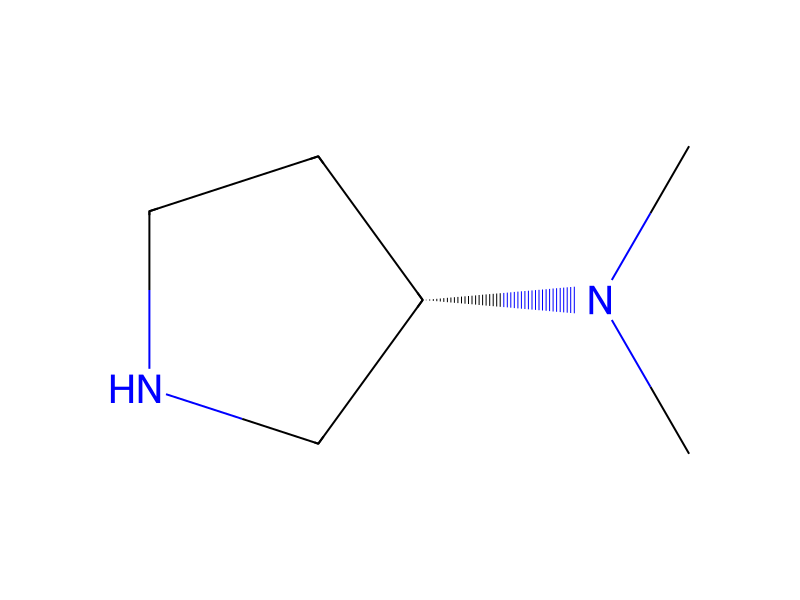
HCID 8471TriethylamineHCID 516892Sodium BicarbonateHCID 7019156(3S)-(-)-3-(Dimethylamino)pyrrolidineHCID 68584412HCID 68584412, Verbindung

Produkt 1

HCID 685874672-Cyclopropyl-7-[(3S)-3-(dimethylamino)pyrrolidin-1-yl]-6-(2-methoxy-1,3-thiazole-4-yl)-5-methyl-1,3-benzoxazole-4-carbonitrileAusbeute 11,1 %

Reagenzien, Katalysatoren, Lösungsmittel 2

HCID 679Dimethyl SulfoxideLösungsmittelHCID 8857Ethyl AcetateLösungsmittel

Reaktionsbedingungen

Temperatur
90 °C

Versuchsvorschrift

2-Cyclopropyl-7-fluoro-6-(2-methoxy-1,3-thiazol-4-yl)-5-methyl-1,3-benzoxazole-4-carbonitrile (I-179) (120 mg, 0.36 mmol) was dissolved in dimethyl sulfoxide (2.4 ml), then at room temperature, triethylamine (76 μl, 0.55 mmol) and (3S)-3-(dimethylamino)pyrrolidine (56 μl, 0.44 mmol) were added. The solution was stirred under nitrogen atmosphere at 90° C. for 18 hours, then cooled to room temperature. This was fractionated with ethyl acetate and an aqueous saturated sodium hydrogencarbonate solution. The aqueous layer was further extracted twice with ethyl acetate. The organic layers were combined, washed with saturated brine, and dried over anhydrous sodium sulfate. The insoluble matter was separated by filtration, then the solvent was evaporated away, and the resulting residue was purified by preparative TLC, in which, as the mobile layer, chloroform:methanol=9:1 was first used and then chloroform:7 N ammonia-containing methanol solution=97:3 was used, thereby obtaining a roughly-purified product (17 mg). This was washed with diisopropyl ether to obtain the entitled compound (6.5 mg, 4.2%) as a white solid.

Aufarbeitung

  1. temperaturecooled to room temperature
  2. extractionThe aqueous layer was further extracted twice with ethyl acetate
  3. washwashed with saturated brine
  4. dry with materialdried over anhydrous sodium sulfate
  5. customThe insoluble matter was separated by filtration
  6. customthe solvent was evaporated away
  7. customthe resulting residue was purified by preparative TLC, in which, as the mobile layer, chloroform
  8. additionchloroform:7 N ammonia-containing methanol solution=97:3

Quellen und Nachweise

ORD-Eintrag
ord-9f05eac1239d4224af3fdd7f9f605403
Quelldatensatz
uspto-grants-2010_06
DOI
10.6084/m9.figshare.5104873.v1
Patentnummer
US07737166B2

Notizen zur Reaktion

Wird geladen…

Auf dieser SeiteKomponentenReaktionsbedingungenVersuchsvorschriftAufarbeitungQuellen und NachweiseNotizen zur Reaktion