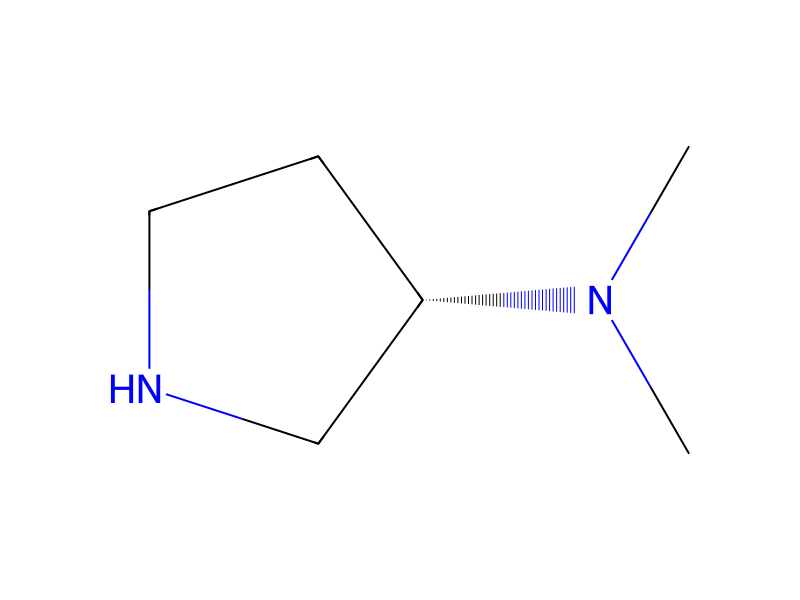
[C:1]([C:3]1[C:8]2[N:9]=[C:10]([C:12]([N:14]([CH3:16])[CH3:15])=[O:13])[O:11][C:7]=2[C:6](F)=[C:5]([C:18]2[CH:23]=[CH:22][CH:21]=[C:20]([F:24])[CH:19]=2)[C:4]=1[CH3:25])#[N:2].C(N(CC)CC)C.[CH3:33][N:34](C)[C@H:35]1[CH2:39][CH2:38][NH:37][CH2:36]1>CS(C)=O>[C:1]([C:3]1[C:8]2[N:9]=[C:10]([C:12]([N:14]([CH3:16])[CH3:15])=[O:13])[O:11][C:7]=2[C:6]([N:37]2[CH2:38][CH2:39][C@H:35]([NH:34][CH3:33])[CH2:36]2)=[C:5]([C:18]2[CH:23]=[CH:22][CH:21]=[C:20]([F:24])[CH:19]=2)[C:4]=1[CH3:25])#[N:2]4-Cyano-7-fluoro-6-(3-fluorophenyl)-N,N,5-trimethyl-1,3-benzoxazole-2-carboxamide (I-184) (75 mg, 0.22 mmol) was dissolved in dimethyl sulfoxide (3.5 ml), then at room temperature, triethylamine (40 μl, 0.29 mmol) was added. The solution was heated at 150° C., a solution of (3S)-3-(dimethylamino)pyrrolidine (30 μl, 0.29 mmol) dissolved in dimethyl sulfoxide (1 ml) was added all at a time. The solution was stirred under nitrogen atmosphere at the same temperature for 1 hour. After cooling to room temperature, the solvent was evaporated away under reduced pressure. The residue was fractionated with chloroform and an aft aqueous saturated sodium hydrogencarbonate solution. The aqueous layer was further extracted twice with chloroform. The organic layers were combined, washed with saturated brine, and dried over anhydrous sodium sulfate. The insoluble matter was separated by filtration, the solvent was evaporated away under reduced pressure, and the resulting residue was purified first by preparative TLC (eluent, chloroform:methanol=9:1) to obtain a roughly-purified form (54 mg). This was further purified by preparative TLC (eluent, chloroform:7 N ammonia-containing methanol solution=95:5), then recrystallized from diisopropyl ether to obtain the entitled compound (12 tag, 13%) as a white solid.