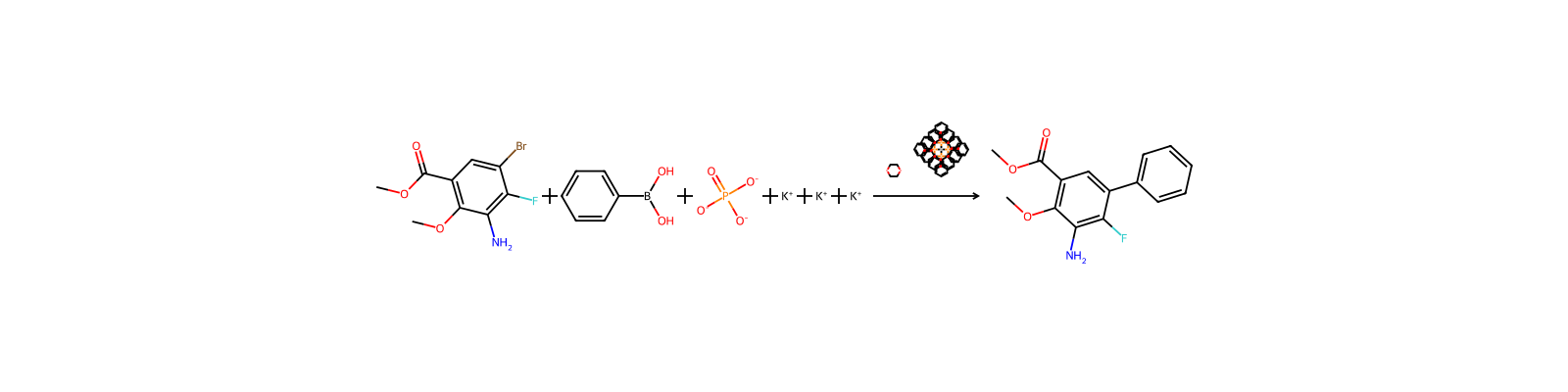
[NH2:1][C:2]1[C:3]([O:14][CH3:15])=[C:4]([CH:9]=[C:10](Br)[C:11]=1[F:12])[C:5]([O:7][CH3:8])=[O:6].[C:16]1(B(O)O)[CH:21]=[CH:20][CH:19]=[CH:18][CH:17]=1.P([O-])([O-])([O-])=O.[K+].[K+].[K+]>O1CCOCC1.C1C=CC([P]([Pd]([P](C2C=CC=CC=2)(C2C=CC=CC=2)C2C=CC=CC=2)([P](C2C=CC=CC=2)(C2C=CC=CC=2)C2C=CC=CC=2)[P](C2C=CC=CC=2)(C2C=CC=CC=2)C2C=CC=CC=2)(C2C=CC=CC=2)C2C=CC=CC=2)=CC=1>[NH2:1][C:2]1[C:3]([O:14][CH3:15])=[C:4]([C:5]([O:7][CH3:8])=[O:6])[CH:9]=[C:10]([C:16]2[CH:21]=[CH:20][CH:19]=[CH:18][CH:17]=2)[C:11]=1[F:12]Methyl 3-amino-5-bromo-4-fluoro-2-methoxybenzoate (I-230) (504 mg, 1.81 mmol) was dissolved in 1,4-dioxane (10 ml), then under nitrogen atmosphere at room temperature, phenylboronic acid (456 mg, 3.62 mmol), tripotassium phosphate (770 mg, 3.62 mmol) and tetrakis(triphenylphosphine)palladium(0) (210 mg, 0.18 mmol) were added. After stirred at 90° C. for 36 hours, this was cooled to room temperature. The insoluble matter was separated by filtration with washing with ethyl acetate, the filtrate was fractionated with ethyl acetate and saturated brine. The organic layer was washed with saturated brine, dried over anhydrous sodium sulfate. The solvent was evaporated away, and the resulting residue was purified by middle-pressure liquid chromatography (eluent, hexane:ethyl acetate=3:1) to obtain the entitled compound (459 mg, 92%) as a colorless gel substance.