Acetone → HCID 922186, Verbindung
HRID 1754326
Reaktionsgleichung
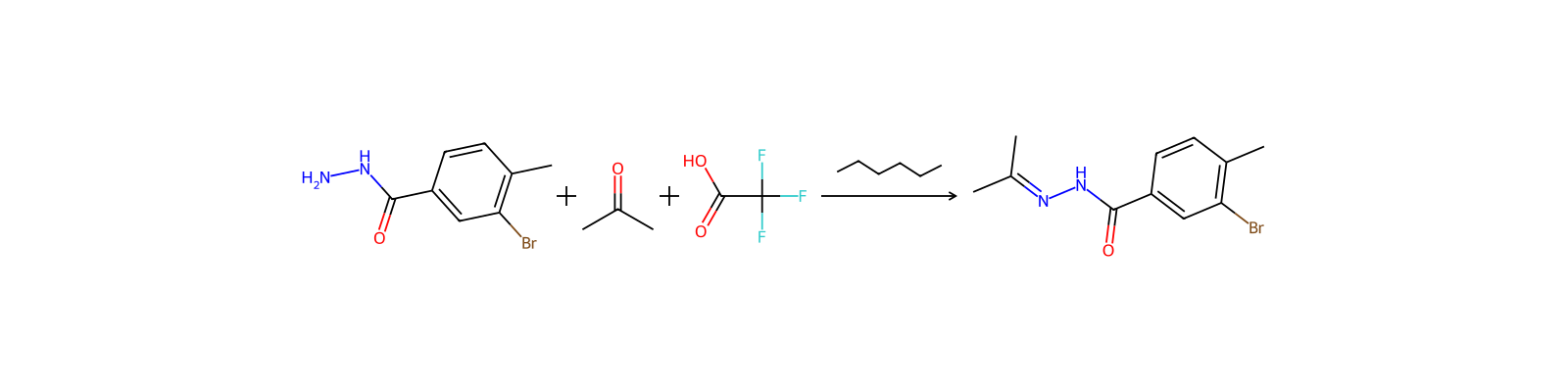
[Br:1][C:2]1[CH:3]=[C:4]([CH:9]=[CH:10][C:11]=1[CH3:12])[C:5]([NH:7][NH2:8])=[O:6].[CH3:13][C:14]([CH3:16])=O.FC(F)(F)C(O)=O>CCCCCC>[Br:1][C:2]1[CH:3]=[C:4]([CH:9]=[CH:10][C:11]=1[CH3:12])[C:5]([NH:7][N:8]=[C:14]([CH3:16])[CH3:13])=[O:6]Komponenten
5
Edukt 3



Produkt 1

Reagenzien, Katalysatoren, Lösungsmittel 1

Versuchsvorschrift
To a mixture of 3-bromo-4-methylbenzohydrazide (2.0 g, 8.72 mmol, 1.0 eq) and acetone (10 mL, 172 mmol, 21 eq) in hexane (10 mL), was added molecular sieves (500 mg) followed by trifluoroacetic acid (2 mL) and the resulting mixture was refluxed for 3 h. The reaction mixture was cooled to room temperature and filtered. The filtrate was concentrated under vacuum and the residue was taken in ethyl acetae (100 mL), washed with water (50 mL), aqueous saturated sodium bicarbonate solution (50 mL), brine (50 mL), dried (Na2SO4) and filtered. The filtrate was concentrated under reduced pressure to afford the 2.10 g of the 3-bromo-4-methyl-N′-(propan-2-ylidene)benzohydrazide. 1HNMR (400 MHz, DMSO-d6) δ 10.51 (s, 1H, D2O exchangeable), 8.02 (s, 1H), 7.75 (dd, J=1.0, 8.0 Hz, 1H), 7.44 (d, J=8.0 Hz, 1H), 2.40 (s, 3H), 2.01 (s, 3H), 1.94 (s, 3H); ESI-MS (m/z) 269, 271 [(MH)+, Br79,81].