Tributyltin azide → HCID 178493528, Verbindung
Reaktionsgleichung
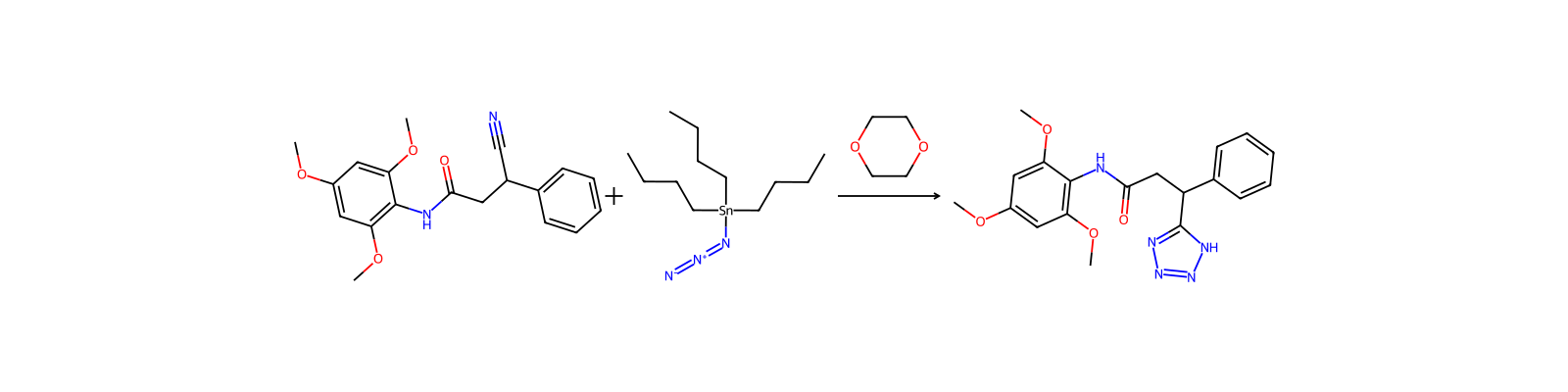
[C:1]([CH:3]([C:20]1[CH:25]=[CH:24][CH:23]=[CH:22][CH:21]=1)[CH2:4][C:5]([NH:7][C:8]1[C:13]([O:14][CH3:15])=[CH:12][C:11]([O:16][CH3:17])=[CH:10][C:9]=1[O:18][CH3:19])=[O:6])#[N:2].C([Sn]([N:39]=[N+:40]=[N-:41])(CCCC)CCCC)CCC>O1CCOCC1>[NH:39]1[C:1]([CH:3]([C:20]2[CH:21]=[CH:22][CH:23]=[CH:24][CH:25]=2)[CH2:4][C:5]([NH:7][C:8]2[C:9]([O:18][CH3:19])=[CH:10][C:11]([O:16][CH3:17])=[CH:12][C:13]=2[O:14][CH3:15])=[O:6])=[N:2][N:41]=[N:40]1Komponenten
4
Edukt 2


Produkt 1

Reagenzien, Katalysatoren, Lösungsmittel 1

Versuchsvorschrift
To a suspension of the material from step (a) (5.1 g, 0.016 mol) in dioxane (150 mL) at room temperature was added tri-n-butyltin azide (9.36 g, 0.016 mol) under N2 with stirring. The resulting solution was heated to reflux for 24 hours. The solution was then cooled and concentrated in vacuo. The residue was redissolved in ether and HCl gas was then passed through the solution for 30 minutes. This was then concentrated in vacuo to give β-(1H-tetrazol-5-yl)-N-(2,4,6-trimethoxyphenyl)benzene propanamide as a white solid (2.1 g) which was used without further purification.
Aufarbeitung
- temperatureThe resulting solution was heated
- temperatureto reflux for 24 hours
- temperatureThe solution was then cooled
- concentrationconcentrated in vacuo
- dissolutionThe residue was redissolved in ether
- concentrationThis was then concentrated in vacuo
Quellen und Nachweise
- ORD-Eintrag
- ord-2c8c1fafb3da4e80ac08d1a5c7e96851
- Quelldatensatz
- uspto-grants-1995_08
- Patentnummer
- US05441975
Notizen zur Reaktion
Wird geladen…