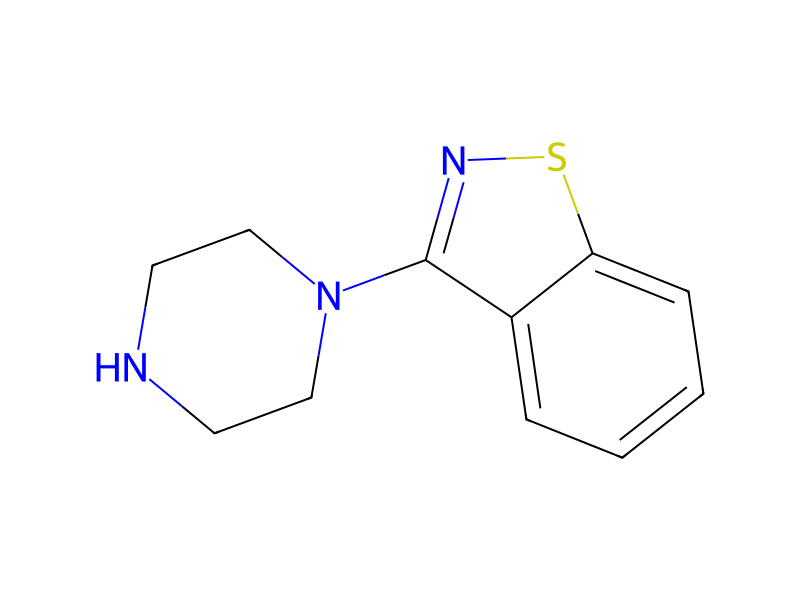
[S:1]1[C:5]2[CH:6]=[CH:7][CH:8]=[CH:9][C:4]=2[C:3]([N:10]2[CH2:15][CH2:14][NH:13][CH2:12][CH2:11]2)=[N:2]1.Br[CH2:17][CH2:18][C:19]1[CH:28]=[CH:27][C:22]2[NH:23][C:24](=[O:26])[O:25][C:21]=2[CH:20]=1.C(=O)([O-])[O-].[Na+].[Na+]>C(C(C)=O)C(C)C>[S:1]1[C:5]2[CH:6]=[CH:7][CH:8]=[CH:9][C:4]=2[C:3]([N:10]2[CH2:11][CH2:12][N:13]([CH2:17][CH2:18][C:19]3[CH:28]=[CH:27][C:22]4[NH:23][C:24](=[O:26])[O:25][C:21]=4[CH:20]=3)[CH2:14][CH2:15]2)=[N:2]1To a 125 ml round-bottomed flask equipped with condenser were added 4.82 g (0.022 mol) of N-(3benzoisothiazolyl)piperazine (prepared according to the procedure given in U.S. Pat. No. 4,411,901), 5.32 g (0.022 mol) of 6-(2-bromo)ethylbenzoxazolone, 2.33 g (0.022 mol) of sodium carbonate, and 50 ml of methyl isobutyl ketone. The mixture was refluxed for 18 hours. The reaction was cooled and partitioned between ethyl acetate and water. The ethyl acetate layer was isolated, washed with water and saturated aqueous sodium chloride solution, dried over sodium sulfate, and evaporated to an oil. The oil was chromatographed on silica gel using ethyl acetate as eluent, and the product fractions collected and triturated with methylene chloride/isopropyl ether to give a white solid, 1 m.p. 185°-187° C. NMR (CDCl3): 1.7 (bs,1H), 2.8 (m,8H), 3.6 (m,4H), 6.9-8.0 (m,7H).