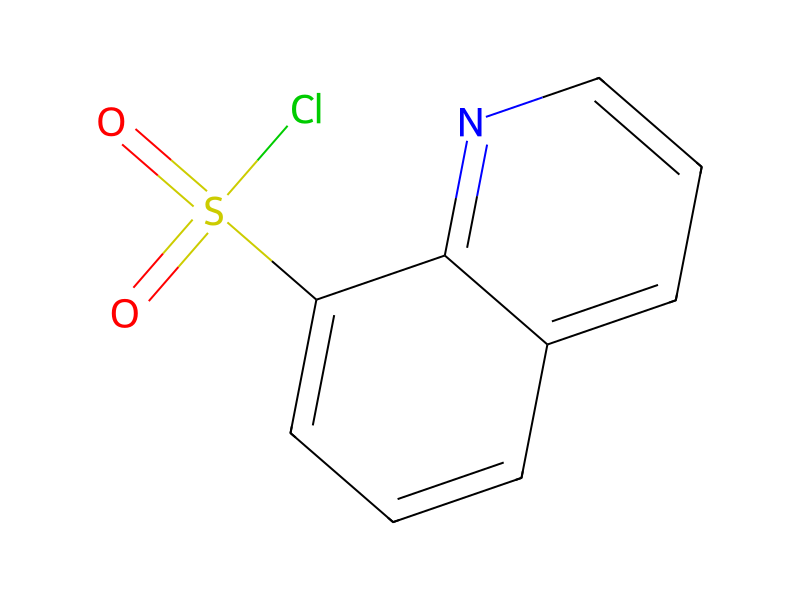
[Br:1][C:2]1[C:10]2[C:5](=[N:6][CH:7]=[CH:8][CH:9]=2)[NH:4][CH:3]=1.[OH-].[Na+].[N:13]1[C:22]2[C:17](=[CH:18][CH:19]=[CH:20][C:21]=2[S:23](Cl)(=[O:25])=[O:24])[CH:16]=[CH:15][CH:14]=1>CCCC[N+](CCCC)(CCCC)CCCC.[Br-].ClCCl>[Br:1][C:2]1[C:10]2[C:5](=[N:6][CH:7]=[CH:8][CH:9]=2)[N:4]([S:23]([C:21]2[CH:20]=[CH:19][CH:18]=[C:17]3[C:22]=2[N:13]=[CH:14][CH:15]=[CH:16]3)(=[O:24])=[O:25])[CH:3]=1Into a round bottom flask was added 3-bromo-7-azaindole (3, 1.18 g, 5.99 mmol) and tetra-N-butylammonium bromide (193 mg, 0.600 mmol), and 5.0 M sodium hydroxide (15.4 mL). 8-Quinoline-sulfonyl chloride (1.64 g, 7.19 mmol) in dichloromethane (5.9 mL) was added dropwise at room temperature. After a few hours, all starting materials were gone. After 30 mL of dichlormethane was added, two layers were separated. The aqueous layer was washed with dichloromethane. The combined organic layers were washed with 1 M sodium bicarbonate, water, and brine and dried over anhydrous sodium sulfate. The crude material was concentrated under reduced pressure and was purified by column chromatography (55-80% ethyl acetate in hexane) to yield the desired product as a light yellow colored solid (44, 1.72 g, 4.43 mmol). MS(ESI) [M+H+]+=389.4.