Reaktionsgleichung

[F-].[K+].[N+:3]([C:6]1[CH:11]=[C:10]([N+:12]([O-:14])=[O:13])[CH:9]=[CH:8][C:7]=1Cl)([O-:5])=[O:4].[SH:16][CH2:17][CH2:18][OH:19].C(=O)([O-])[O-].[K+].[K+]>CN(C)C=O>[N+:3]([C:6]1[CH:11]=[C:10]([N+:12]([O-:14])=[O:13])[CH:9]=[CH:8][C:7]=1[S:16][CH2:17][CH2:18][OH:19])([O-:5])=[O:4]Komponenten
Edukt 4

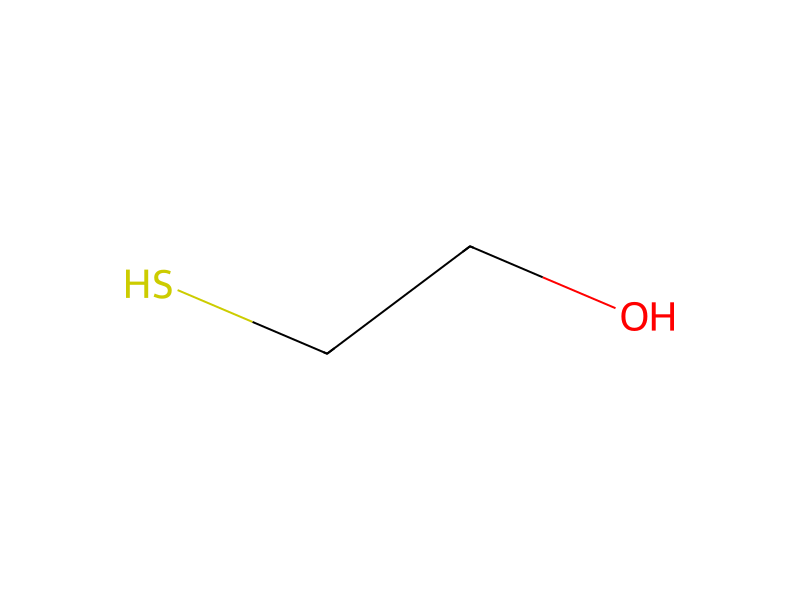


Produkt 1

Reagenzien, Katalysatoren, Lösungsmittel 1

Versuchsvorschrift
217 parts of potassium fluoride are introduced into a solution of 500 parts of 2,4-dinitro-1-chlorobenzene in 590 parts of N,N-dimethylformamide (DMF) and the reaction mixture is stirred for 5 hours at room temperature. 350 parts of 2-mercaptoethanol are then added dropwise, whereupon the internal temperature rises to from 60 to 65° C., and stirring is then carried out for about 15 hours at that temperature. Then, any starting materials still present are made to react by adding 34 parts of potassium carbonate. Finally, the mixture is left to cool to room temperature, salts are filtered off and the filtrate is concentrated. The oily crude product is discharged onto water, whereupon a yellow crystalline precipitate separates out. After filtering off under suction, washing and drying, 2-[2,4-dinitrophenylsulfanyl]ethanol is obtained in an almost quantitative yield and high purity.
Aufarbeitung
- customrises to from 60 to 65° C.
- stirringstirring
- waitis then carried out for about 15 hours at that temperature
- customto react
- waitFinally, the mixture is left
- temperatureto cool to room temperature
- filtrationsalts are filtered off
- concentrationthe filtrate is concentrated
- filtrationAfter filtering off under suction
- washwashing
- customdrying
Quellen und Nachweise
- ORD-Eintrag
- ord-dd982d2c7c574d2c893625c10d8252f6
- Quelldatensatz
- uspto-grants-2006_05
- Patentnummer
- US07038024B2
Verknüpfte Notizen
Wird geladen…