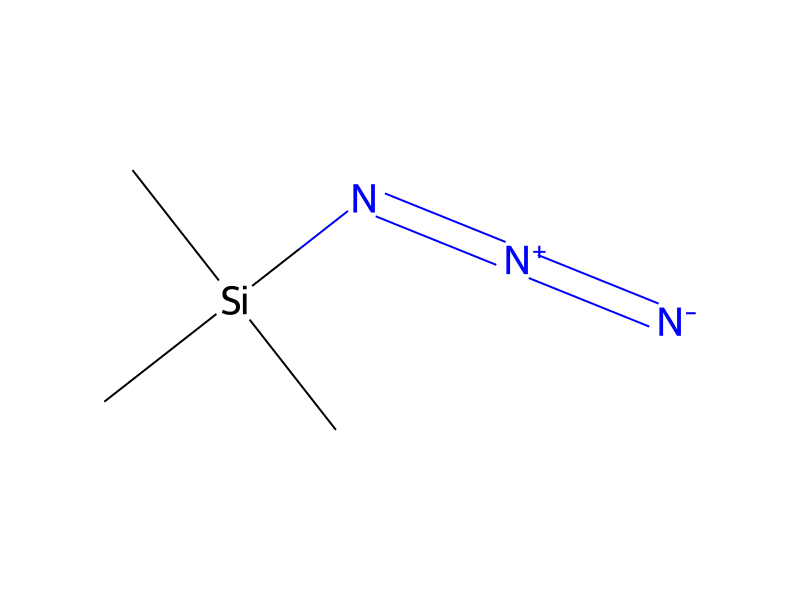
Azidotrimethylsilane → HCID 178424698, Verbindung
HRID 1826708
Reaktionsgleichung

[CH:1]([C:4]1[N:8]2[CH:9]=[C:10]([C:13]#[C:14][C:15]3[CH:20]=[CH:19][CH:18]=[C:17]([CH3:21])[N:16]=3)[CH:11]=[CH:12][C:7]2=[N:6][N:5]=1)([CH3:3])[CH3:2].[N:22]([Si](C)(C)C)=[N+:23]=[N-:24]>CN(C=O)C>[CH:1]([C:4]1[N:8]2[CH:9]=[C:10]([C:13]3[N:22]=[N:23][NH:24][C:14]=3[C:15]3[CH:20]=[CH:19][CH:18]=[C:17]([CH3:21])[N:16]=3)[CH:11]=[CH:12][C:7]2=[N:6][N:5]=1)([CH3:3])[CH3:2]Komponenten
4
Edukt 2

Produkt 1

Reagenzien, Katalysatoren, Lösungsmittel 1

Versuchsvorschrift
To a 10 mL flask was added 100 mg (0.36 mmol) of 3-Isopropyl-6-(6-methylpyridin-2-ylethynyl)-[1,2,4]triazolo(4,3-a)pyridine, 1.5 mL of anhydrous DMF, and 168 μL (1.3 mmol) of azidotrimethylsilane. The reaction mixture was heated to reflux for 16 hours. After concentrating, the residue was suspended in 30 mL of water and was extracted with (2×30 mL) ethyl acetate. The organic extracts were combined, washed with 20 mL of water, 20 mL of brine, dried over magnesium sulfate, filtered, and concentrated. Product was purified by Shimodzu prep. HPLC using a 5 to 60% acetonitrile/buffer gradient (buffer is water with 0.1% formic acid, and the acetonitrile contains 0.1% formic acid as well) which yielded 45 milligrams (39%) of a light brown solid. HPLC tR=3.71 min (98%), LC-MS=320 (M+1).