Reaktionsgleichung

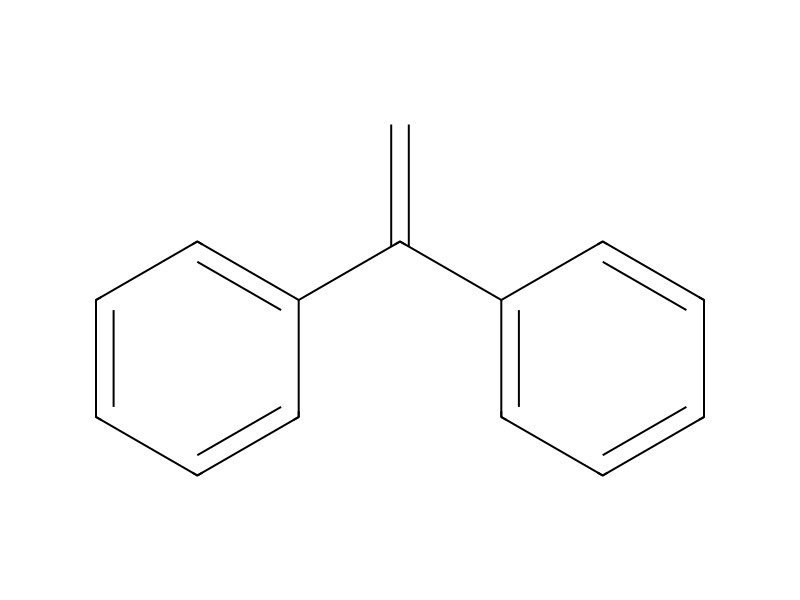
C1(C=CC2C=CC=CC=2)C=CC=CC=1.[C:15]1([C:21]([C:23]2[CH:28]=[CH:27][CH:26]=[C:25](C(C3C=CC=CC=3)=C)[CH:24]=2)=[CH2:22])[CH:20]=[CH:19][CH:18]=[CH:17][CH:16]=1.C1(C(C2C=CC(C(C3C=CC=CC=3)=C)=CC=2)=C)C=CC=CC=1>>[C:15]1([C:21]([C:23]2[CH:24]=[CH:25][CH:26]=[CH:27][CH:28]=2)=[CH2:22])[CH:20]=[CH:19][CH:18]=[CH:17][CH:16]=1Komponenten


Versuchsvorschrift
For instance, in accordance with an embodiment of the present inveniton, a living macrocarbocation, e.g., living cationic polyisobutylene, is reacted with a double diphenylethylene, e.g., 1,3-bis(1-phenylethenyl)benzene (sometimes referred to as meta-double diphenylethylene) or 1,4-bis(1-phenylethenyl)benzene (sometimes referred to as para-double diphenylethylene), to produce a 1,1-diphenylethylene end-functionalized carbocationic polymer. The carbocation is then alkylated with a suitable alkylating agent, e.g., with an organometallic compound such as dimethylzinc, whereupon the resulting macromonomer is readily metallated with a suitable organometallic compound such as an alkyllithium compound, thereby providing a living anionic macroinitiator in near quantitative yield. A sterically hindered lithium compound, e.g., a 1,1-diphenylalkyllithium species, is used in certain embodiments to remove impurities that may be present alongside the 1,1-diphenylethylene end-functionalized polymer, thereby preventing premature termination of the living macroanion.
Quellen und Nachweise
- ORD-Eintrag
- ord-9fbca44ee16f4ba08f982fb4ed559920
- Quelldatensatz
- uspto-grants-2006_06
- Patentnummer
- US07056985B2
Verknüpfte Notizen
Wird geladen…