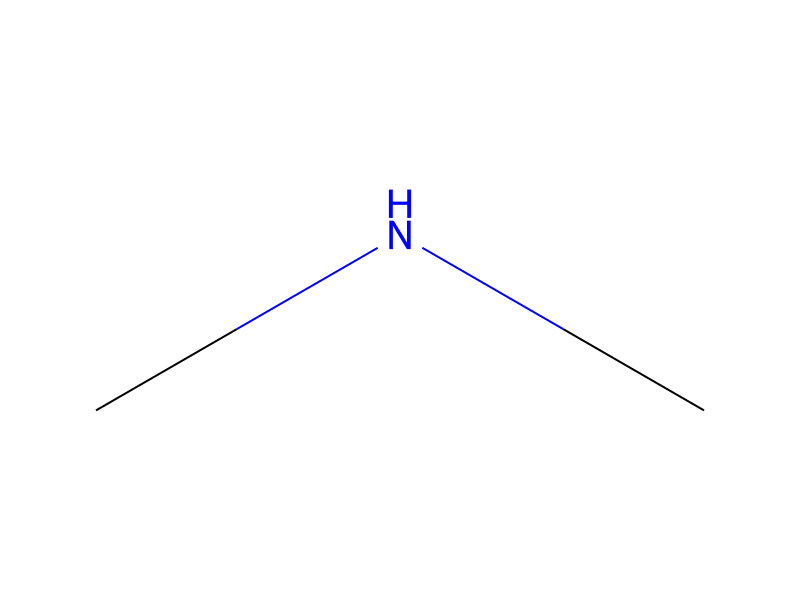
To a stirred solution of 1-methyl-1,3,4,9-tetrahydropyrano[3,4-b]indole-1-acetic acid (15 g, 0.061 mole), prepared as described in Example 1, in dry tetrahydrofuran (300 ml), cooled to -5° C., is added triethylamine (18.5 g, 0.183 mole), followed by ethyl chloroformate (16.6 g, 0.153 mole). The mixture is stirred at -5° C. for 2 hr. This mixture, which now contains the mixed anhydride of the above starting material, is added dropwise to a cooled 40% aqueous solution of the amine, dimethylamine (225 ml). The resulting mixture is stirred at room temperature for one-half hour. Most of the tetrahydrofuran is evaporated, and the residue partitioned between chloroform and water. The organic phase is washed with water, dried over sodium sulfate, and evaporated under reduced pressure. The residue is subjected to chromatography on silica gel. Elution with 20% ethyl acetate in benzene, followed by crystallization of the eluate from ethyl acetate affords the title compound, m.p. 149° - 151° C., νmaxCHCl3 3375, 1634 cm-1.