Sodium Carbonate → 2-[4-(Trifluoromethyl)phenyl]pyrazine
Reaktionsgleichung

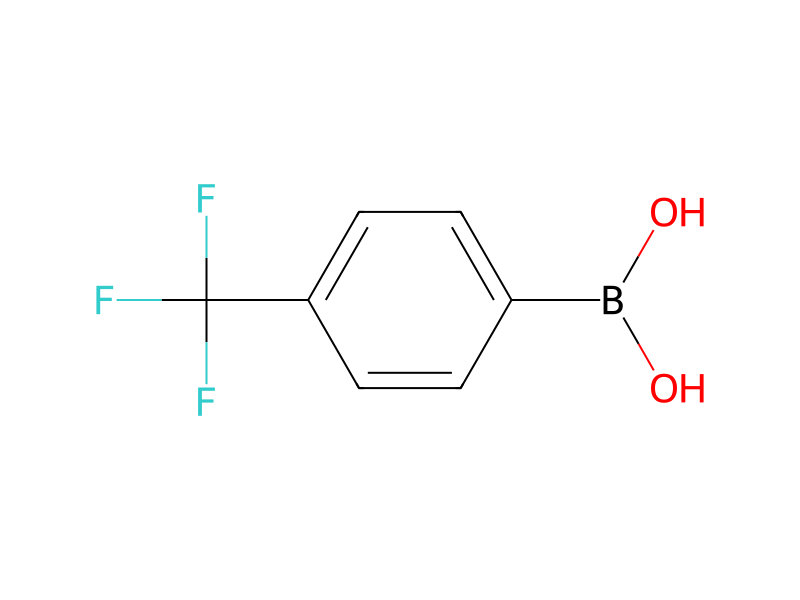
Cl[C:2]1[CH:7]=[N:6][CH:5]=[CH:4][N:3]=1.[F:8][C:9]([F:20])([F:19])[C:10]1[CH:15]=[CH:14][C:13](B(O)O)=[CH:12][CH:11]=1.C(=O)([O-])[O-].[Na+].[Na+]>O1CCOCC1.[Cl-].[Cl-].C1(P([C-]2C=CC=C2)C2C=CC=CC=2)C=CC=CC=1.[CH-]1C=CC=C1.[Fe+2].[Pd+2]>[F:8][C:9]([F:20])([F:19])[C:10]1[CH:15]=[CH:14][C:13]([C:2]2[CH:7]=[N:6][CH:5]=[CH:4][N:3]=2)=[CH:12][CH:11]=1Komponenten
6





Versuchsvorschrift
A mixture of chloropyrazine (10, 0.087 mol), 4-(trifluoromethyl)phenylboronic acid (21 g), palladium(diphenylphosphino)ferrocene dichloride (3.5 g, 5 mol %) and sodium carbonate (100 mL, 2M) in dioxane (200 mL) was degassed (×3) via Firestone valve. The mixture was heated under reflux for 1 h., evaporated in vacuo, the residue partitioned between ethyl acetate and water, then the organic phase was washed with brine, dried (MgSO4) and evaporated. The black residue was dry-loaded onto silica and purified by elution with 5-25% ethyl acetate in iso-hexane. This afforded the product as white crystals.
Aufarbeitung
- customwas degassed (×3) via Firestone valve
- temperatureThe mixture was heated
- temperatureunder reflux for 1 h.
- customevaporated in vacuo
- customthe residue partitioned between ethyl acetate and water
- washthe organic phase was washed with brine
- dry with materialdried (MgSO4)
- customevaporated
- custompurified by elution with 5-25% ethyl acetate in iso-hexane
Quellen und Nachweise
- ORD-Eintrag
- ord-a764eaa7aee84b359078935a8acc89f5
- Quelldatensatz
- uspto-grants-2009_12
- Patentnummer
- US07638629B2
Notizen zur Reaktion
Wird geladen…