HuagongsheHuagongshe Chemie-Druckbericht · Nur für Forschungszwecke
1,4-Diiodobutane → (4aRS,5SR,8aRS)-1-benzyl-5-(pyrrolidin-1-yl)perhydroquinoxaline-2,3-dione
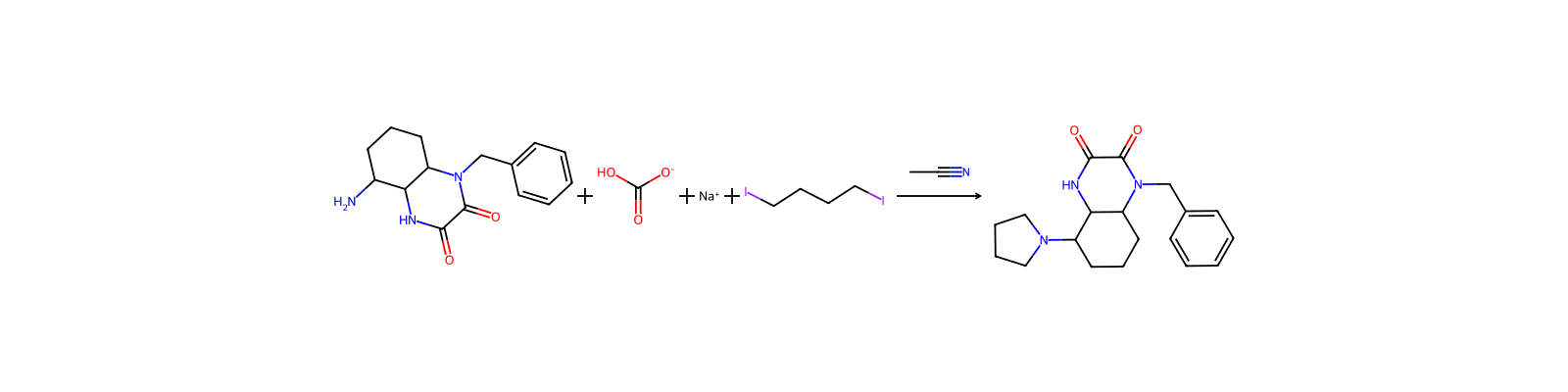
Beteiligte Stoffe
| Rolle | Name | HCID | Einwaage |
|---|---|---|---|
| Edukt | 1,4-Diiodobutane | HCID 12337 | — |
| Edukt | Sodium Bicarbonate | HCID 516892 | — |
| Edukt | (4aRS,5SR,8aRS)-5-amino-1-benzylperhydroquinoxaline-2,3-dione | HCID 68777664 | — |
| Lösungsmittel | Acetonitrile | HCID 6342 | — |
| Produkt | (4aRS,5SR,8aRS)-1-benzyl-5-(pyrrolidin-1-yl)perhydroquinoxaline-2,3-dione | HCID 68777117 | — |
Reaktionsschritte
(4aRS,5SR,8aRS)-5-Amino-1-benzylperhydroquinoxaline-2,3-dione (3.06 g, 11.2 mmol) was dissolved in CH3CN (300 ml). NaHCO3 (6.4 g, 76.2 mmol) and 1,4-diiodobutane (13.9 g, 44.8 mmol, 5.9 ml) were added and the mixture was heated under reflux for 18 hours. NaHCO3 was separated off with a blue-band filter (Schleicher&Schuell) and the yellow solution was concentrated in vacuo. The solid was taken up in CH2Cl2 and the mixture was extracted by shaking three times with HCl (1 N). The aqueous phase was then brought to pH 8 with NaOH (2 N) and extracted by shaking three times with CH2Cl2. The organic phases were dried over Na2SO4 and evaporated in vacuo. A pale yellow solid was obtained.
Herkunft & Nachweise
| DOI | 10.6084/m9.figshare.5104873.v1 |
|---|---|
| Patentnummer | US08309725B2 |
| Quelldatensatz | uspto-grants-2012_11 |
| ORD ID | ord-f8523a2b440a489c84e2be6a3be9cf77 |
| Quellennotiz | uspto-grants-2012_11 |