Pyrrolidine → 2-Nitro-5-methoxy-6-chloro-beta-pyrrolidinostyrene
Reaktionsgleichung

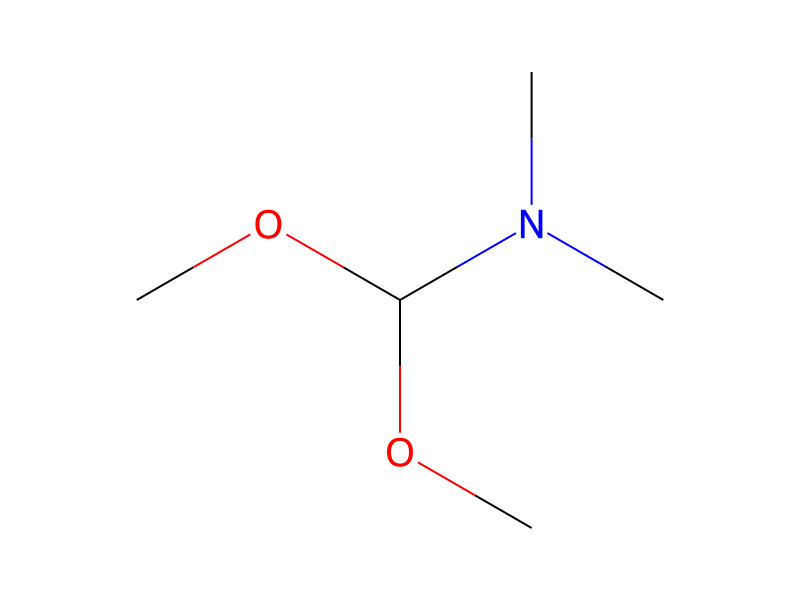
[Cl:1][C:2]1[C:7]([CH3:8])=[C:6]([N+:9]([O-:11])=[O:10])[CH:5]=[CH:4][C:3]=1[O:12][CH3:13].CO[CH:16](OC)[N:17]([CH3:19])[CH3:18].N1CC[CH2:24][CH2:23]1>CN(C=O)C>[N+:9]([C:6]1[CH:5]=[CH:4][C:3]([O:12][CH3:13])=[C:2]([Cl:1])[C:7]=1[CH:8]=[CH:19][N:17]1[CH2:16][CH2:24][CH2:23][CH2:18]1)([O-:11])=[O:10]Komponenten
5




Versuchsvorschrift
After reaction of 2-chloro-3-methyl-4-nitroanisole (32.1 g, 159 mmol) with dimethylformamide dimethylacetal (22.6 g, 190 mmol) and pyrrolidine (13.4 g, 188 mmol) in DMF (150 ml) at 120°-140° C. for 1 hour under a slow current of nitrogen, the volatile components were removed under vacuum. To the residue was added dichloromethane (90 ml) and methanol (360 ml) and the solution was evaporated to about half its original volume by heating on a steam bath. After cooling, the solution was left refrigerated overnight to yield 2-nitro-5-methoxy-6-chloro-β-pyrrolidinostyrene as red crystals (33.9 g) m.p. 89°-92° C.
Aufarbeitung
- customthe volatile components were removed under vacuum
- additionTo the residue was added dichloromethane (90 ml) and methanol (360 ml)
- customthe solution was evaporated to about half its original volume
- temperatureby heating on a steam bath
- temperatureAfter cooling
Quellen und Nachweise
- ORD-Eintrag
- ord-da2f1591cdbd42f69a65626ca2f86002
- Quelldatensatz
- uspto-grants-1996_11
- Patentnummer
- US05571833
Notizen zur Reaktion
Wird geladen…