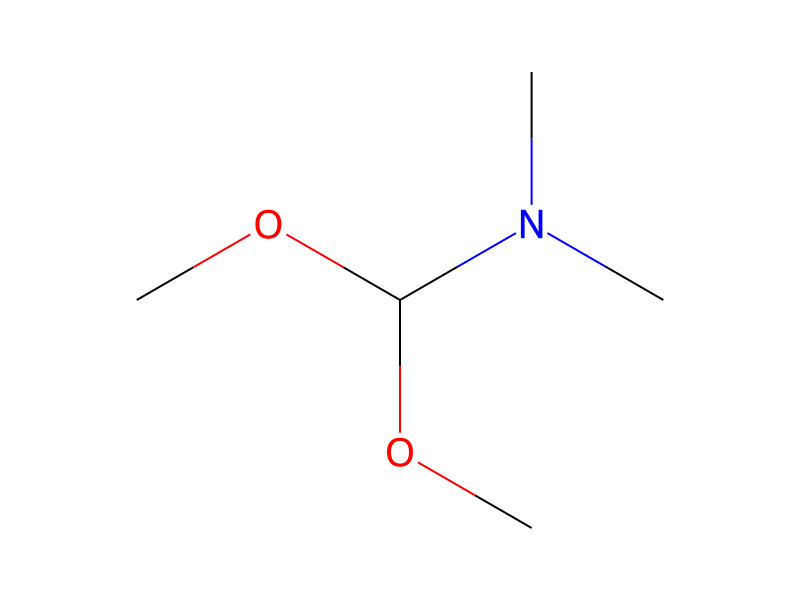
Dimethylformamide dimethyl acetal → 5-Bromo-3-(dimethylaminomethyleneamino)thiophene-2-carboxylic acid methyl ester
Reaktionsgleichung

[Br:1][C:2]1[S:6][C:5]([C:7]([O:9][CH2:10]C)=[O:8])=[C:4]([NH2:12])[CH:3]=1.CO[CH:15](OC)[N:16]([CH3:18])[CH3:17]>CCO>[Br:1][C:2]1[S:6][C:5]([C:7]([O:9][CH3:10])=[O:8])=[C:4]([N:12]=[CH:15][N:16]([CH3:18])[CH3:17])[CH:3]=1Komponenten
4
Edukt 2

Produkt 1

Reagenzien, Katalysatoren, Lösungsmittel 1

Versuchsvorschrift
A solution of ethyl 5-bromo-3-amino-2-thiophenecarboxylate (1.0 g, 4.2 mmol) and dimethylformamide dimethylacetal (1.1 mL, 8.5 mmol) in EtOH (30 mL). was heated to reflux for 50 min. After cooling, the solvent was removed in vacuo. The residue was coevaporated with toluene (2×20 mL) to yield methyl 5-bromo-3-(((dimethylamino)methylene)amino)-2-thiophenecarboxylate. The residue and 1-((4-amino-2-methoxy)phenoxy)-2-methyl-2-propanol (0.90 mg, 4.2 mmol) (described in Part B of Example 82) were mixed with phenol (4 g) prior to heating at 130° C. for 40 min. After cooling, the mixture was chromatographed (120 g silica, CH2Cl2 to 50% EtOAc-CH2Cl2) to provide 1-(4-(6-bromo-4-oxo-thieno[3,2-d]pyrimidin-3(4H)-yl)-2-methoxyphenoxy)-2-methyl-2-propanol as a tan solid (1.2 g, 67%).