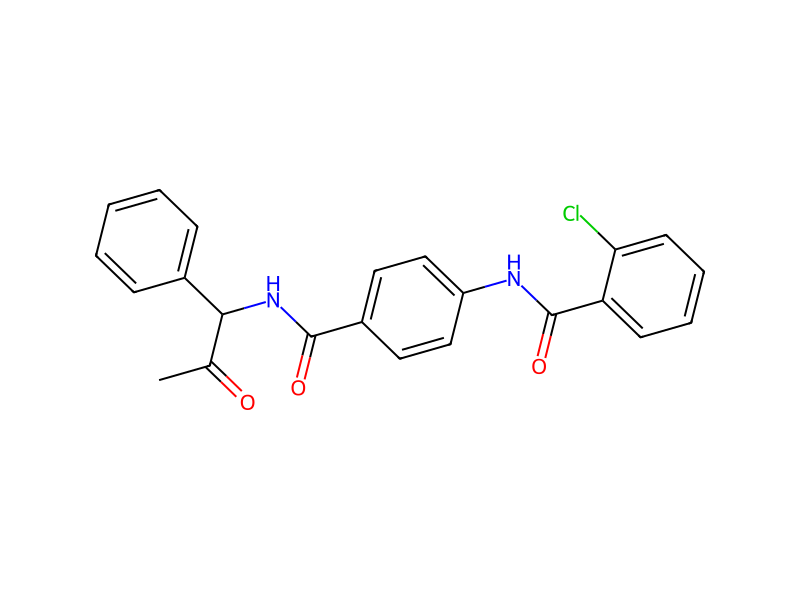
[Cl:1][C:2]1[CH:29]=[CH:28][CH:27]=[CH:26][C:3]=1[C:4]([NH:6][C:7]1[CH:12]=[CH:11][C:10]([C:13]([NH:15][CH:16]([C:20]2[CH:25]=[CH:24][CH:23]=[CH:22][CH:21]=2)[C:17](=O)[CH3:18])=[O:14])=[CH:9][CH:8]=1)=[O:5].P(Cl)(Cl)(Cl)=O.C(=O)(O)[O-].[Na+]>N1C=CC=CC=1>[Cl:1][C:2]1[CH:29]=[CH:28][CH:27]=[CH:26][C:3]=1[C:4]([NH:6][C:7]1[CH:8]=[CH:9][C:10]([C:13]2[O:14][C:17]([CH3:18])=[C:16]([C:20]3[CH:25]=[CH:24][CH:23]=[CH:22][CH:21]=3)[N:15]=2)=[CH:11][CH:12]=1)=[O:5]a solution of 2-chloro-N-(4-(((2-oxo-1-phenylpropyl)amino)carbonyl)phenyl)benzamide (90 mg, 221 μmol) and phosphoryl trichloride (1.5 mL, 16093 μmol) in 2 mL pyridine was heated in a 70° C. oil bath. After 2 hours the reaction was poured into 10 mL saturated aqueous sodium bicarbonate solution and stirred vigorously for 30 minutes. The aqueous mixture was extracted with 25 mL ethyl acetate. The organic extract was washed with 10 mL each water then brine. The organic layer was stirred over magnesium sulfate, filtered and the filtrate concentrated under reduced pressure to afford a yellow-green oil. TLC indicated a very complex mixture of products. The crude product was purified by reversed-phase preparative HPLC to afford a colorless film (4 mg, 5%). ESI+ m/z=389.0 [MH]+.