3-Aminobenzyl alcohol → HCID 23295774, Verbindung
HRID 1954029
Reaktionsgleichung

F[C:2]1[CH:7]=[C:6]([F:8])[C:5]([C:9]([F:12])([F:11])[F:10])=[CH:4][C:3]=1[N+:13]([O-:15])=[O:14].[NH2:16][C:17]1[CH:18]=[C:19]([CH:22]=[CH:23][CH:24]=1)[CH2:20][OH:21]>C(O)C>[F:8][C:6]1[C:5]([C:9]([F:12])([F:11])[F:10])=[CH:4][C:3]([N+:13]([O-:15])=[O:14])=[C:2]([CH:7]=1)[NH:16][C:17]1[CH:18]=[C:19]([CH2:20][OH:21])[CH:22]=[CH:23][CH:24]=1Komponenten
4
Edukt 2
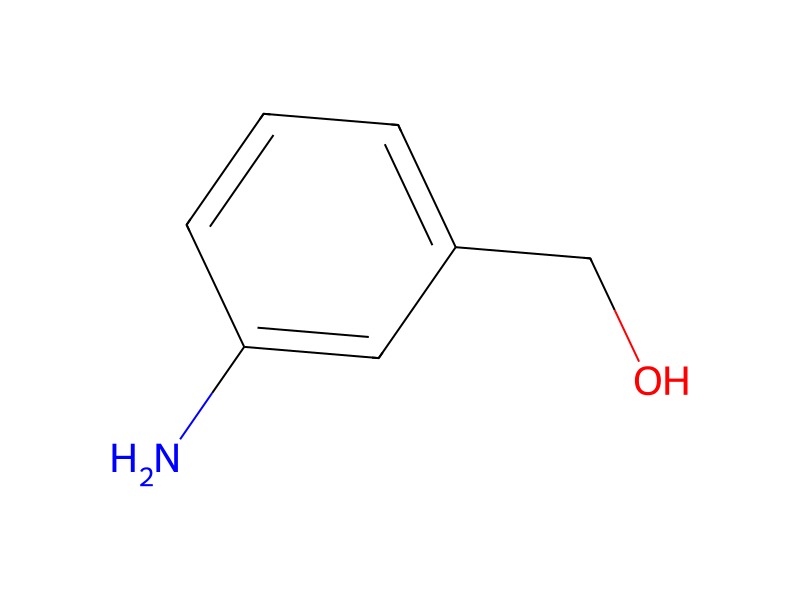

Produkt 1

Reagenzien, Katalysatoren, Lösungsmittel 1

Versuchsvorschrift
With ice-cooling, 1,5-difluoro-2-nitro-4-trifluoromethylbenzene (1.50 g) and 3-aminobenzyl alcohol (1.62 g) were dissolved in ethanol (50 ml) and subjected to 3 hours of the reaction at room temperature. The reaction solution was concentrated and the resulting residue was purified by a silica gel column chromatography (chloroform:methanol=100:1) to give [3-(5-fluoro-2-nitro-4-trifluoromethylanilino)phenyl]methanol (1.93 g). The resulting anilinophenylmethanol (1.75 g) and imidazole (3.61 g) were allowed to react with each other in DMF (50 ml) at 140° C. for 30 minutes, and the resulting reaction solution was spontaneously cooled down to room temperature. Then, saturated sodium chloride aqueous solution (150 ml) was added. The thus formed orange solid was collected by filtration, washed with water and then dried under a reduced pressure. The resulting crude crystals were purified by a silica gel column chromatography (chloroform:methanol=10:1) to give [3-[5-(1H-imidazol-1-yl)-2-nitro-4-trifluoromethylanilino]phenyl]methanol (1.46 g). In an atmosphere of hydrogen, the thus formed product (1.37 g) in methanol was subjected to reduction under ordinary pressure using palladium-carbon as the catalyst. The reaction solution was filtered and concentrated under a reduced pressure to give amorphous residue. Then, oxalic acid (0.13 g) and 1 N hydrochloric acid aqueous solution (10 ml) were added, followed by heating at 100° C. for 15 hours. When the reaction solution was concentrated to about half in volume, the thus formed crystals were collected by filtration, washed with ethyl acetate and then dried under a reduced pressure to give 1-(3-hydroxymethylphenyl)-7-(1H-imidazol-1-yl)-6-trifluoromethyl-2,3(1H,4H)-quinoxalinedione hydrochloride (1.20 g).