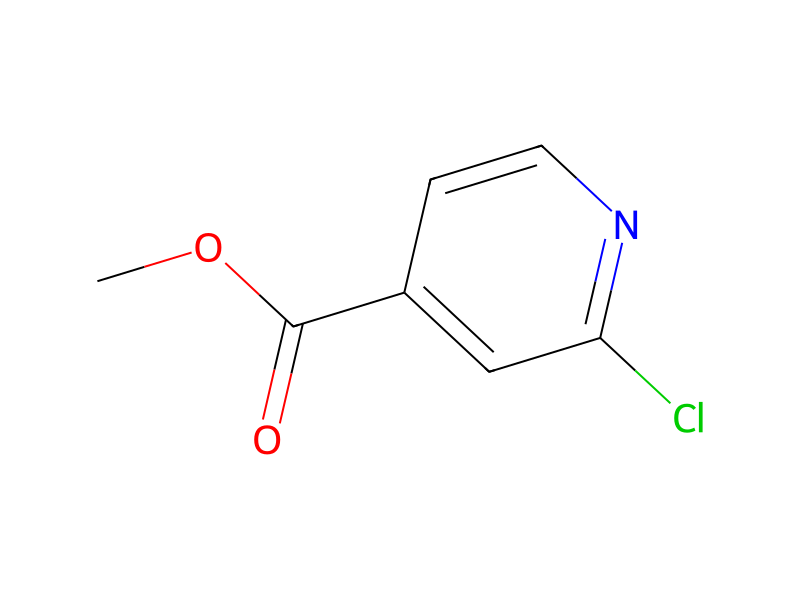
Cl[C:2]1[CH:3]=[C:4]([CH:9]=[CH:10][N:11]=1)[C:5]([O:7][CH3:8])=[O:6].[Br-].[F:13][C:14]1[CH:15]=[C:16]([CH:19]=[C:20]([C:22]([F:25])([F:24])[F:23])[CH:21]=1)[CH2:17][Zn+]>C1COCC1.C1C=CC([P]([Pd]([P](C2C=CC=CC=2)(C2C=CC=CC=2)C2C=CC=CC=2)([P](C2C=CC=CC=2)(C2C=CC=CC=2)C2C=CC=CC=2)[P](C2C=CC=CC=2)(C2C=CC=CC=2)C2C=CC=CC=2)(C2C=CC=CC=2)C2C=CC=CC=2)=CC=1>[F:13][C:14]1[CH:15]=[C:16]([CH:19]=[C:20]([C:22]([F:23])([F:24])[F:25])[CH:21]=1)[CH2:17][C:2]1[CH:3]=[C:4]([CH:9]=[CH:10][N:11]=1)[C:5]([O:7][CH3:8])=[O:6]Methyl 2-chloroisonicotinate (3.0 g, 17.48 mmol) and Pd(PPh3)4 (0.606 g, 0.52 mmol) were dissolved in THF (50 mL) under nitrogen. Freshly prepared (3-fluoro-5-(trifluoromethyl)benzyl)zinc(II) bromide (5.41 g, 19.45 mmol) in THF (25 mL) was added to the yellow solution and the flask was warmed to 60° C. overnight. The reaction mixture was quenched by adding methanol. The solution was diluted with ethyl acetate and washed with NH4Cl and water. The organic layer was dried with Na2SO4, filtered through celite, and the solvent was evaporated. The residue was chromatographed using the Biotage equipment. Eluent ethyl acetate-heptane, started 20-80 and linear gradient until 60-40. Methyl 2-(3-fluoro-5-(trifluoromethyl)benzyl)isonicotinate (4.1 g, 75% yield) was isolated. 1H NMR (400 MHz, cdcl3) δ 3.94 (s, 3H), 4.25 (s, 2H), 7.13-7.22 (m, 2H), 7.33 (s, 1H), 7.69-7.75 (m, 2H), 8.70-8.74 (m, 1H). MS m/z 314 (M+H)+