StartseiteMCPWorkbenchSkills
StartseiteWorkbenchBenachrichtigungenMein Bereich
llms.txt · MCP-AnleitungDatenschutz · Nutzungsbedingungen · Supportv1.8.0
  1. Startseite
  2. /Reaktion

Potassium Carbonate → HCID 58229488, Verbindung

HRID 1963776
Notizen
Druckvorschau

Reaktionsgleichung

Reaktionsgleichung von HRID 1963776
[Cl:1][C:2]1[C:7]([NH:8][S:9]([C:12]2[CH:17]=[CH:16][C:15]([F:18])=[CH:14][CH:13]=2)(=[O:11])=[O:10])=[CH:6][C:5](B2OC(C)(C)C(C)(C)O2)=[CH:4][N:3]=1.Br[C:29]1[CH:30]=[C:31]2[C:36](=[CH:37][CH:38]=1)[N:35]=[CH:34][C:33]([OH:39])=[CH:32]2.C(=O)([O-])[O-].[K+].[K+]>O1CCOCC1.C1C=CC(P(C2C=CC=CC=2)[C-]2C=CC=C2)=CC=1.C1C=CC(P(C2C=CC=CC=2)[C-]2C=CC=C2)=CC=1.Cl[Pd]Cl.[Fe+2].C(Cl)Cl>[Cl:1][C:2]1[C:7]([NH:8][S:9]([C:12]2[CH:13]=[CH:14][C:15]([F:18])=[CH:16][CH:17]=2)(=[O:10])=[O:11])=[CH:6][C:5]([C:29]2[CH:30]=[C:31]3[C:36](=[CH:37][CH:38]=2)[N:35]=[CH:34][C:33]([OH:39])=[CH:32]3)=[CH:4][N:3]=1
KomponentenVersuchsvorschriftAufarbeitungQuellen und NachweiseNotizen zur Reaktion

Komponenten

6

Edukt 3

HCID 11430Potassium CarbonateHCID 170396516-Bromoquinolin-3-olHCID 53363355n-[2-Chloro-5-(4,4,5,5-tetramethyl-1,3,2-dioxaborolan-2-yl)pyridin-3-yl]-4-fluorobenzene-1-sulfonamide

Produkt 1

HCID 58229488HCID 58229488, VerbindungAusbeute 63,1 %

Reagenzien, Katalysatoren, Lösungsmittel 2
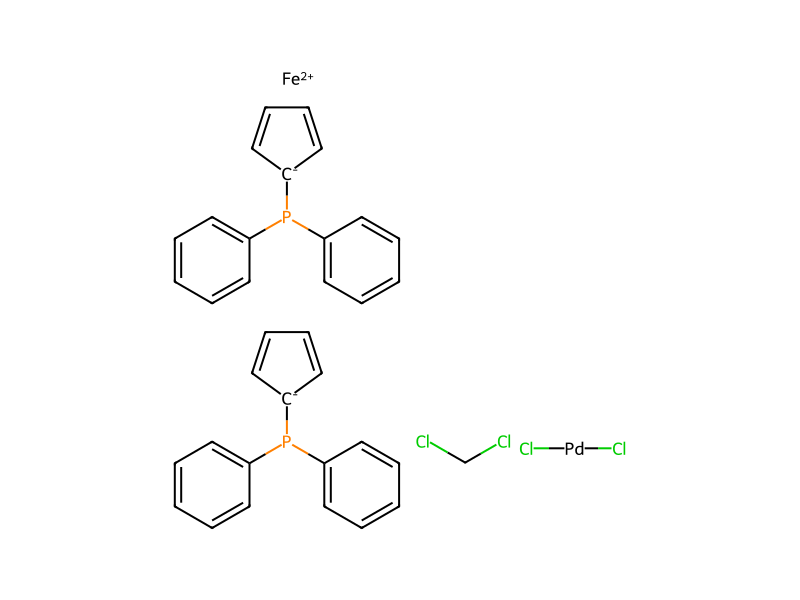
HCID 178418807
HCID 178418807, Verbindung
Katalysator
HCID 312751,4-DioxaneLösungsmittel

Versuchsvorschrift

To a microwave vial (5 mL) was added N-(2-chloro-5-(4,4,5,5-tetramethyl-1,3,2-dioxaborolan-2-yl)pyridin-3-yl)-4-fluorobenzenesulfonamide (0.129 g, 0.312 mmol), 6-bromoquinolin-3-ol (Li et. Al, Bioorganic & Medicinal Chemistry Letters (2006), 16(7), 2000-2007) (0.0703 g, 0.314 mmol), PdCl2(dppf)-CH2Cl2 adduct (0.0128 g, 0.0156 mmol) and potassium carbonate (2.0 M, 0.390 mL, 0.781 mmol) in 1,4-dioxane (3 mL). The mixture was degassed by bubbling nitrogen through for 10 min. The tube was irradiated with microwave at 100° C. for 10 min. The reaction mixture was cooled to RT then partitioned between water (10 mL) and EtOAc (10 mL). The product went into aqueous almost exclusively. The aqueous phase was passed through BE-SCX column (Varian, Palo Alto, Calif., 10 gm) then eluted with MeOH. MeOH fraction contains the product. MeOH was evaporated and yielded a brown solid (0.0846 g) as the desired product. m/z: calc'd for C20H13ClFN3O3S: 429.0; found 430.0 (M+1). 1H NMR (300 MHz, DMSO-d6) δ ppm 7.21-7.35 (m, 2 H), 7.52-7.65 (m, 2 H), 7.74-7.86 (m, 3 H), 7.89 (d, J=1.8 Hz, 1 H), 7.96 (d, J=8.6 Hz, 1 H), 8.03-8.15 (m, 1 H), 8.58 (d, J=2.8 Hz, 1 H), 10.40 (s, 1 H).

Aufarbeitung

  1. customThe mixture was degassed
  2. customby bubbling nitrogen through for 10 min
  3. customThe tube was irradiated with microwave at 100° C. for 10 min
  4. customthen partitioned between water (10 mL) and EtOAc (10 mL)
  5. washthen eluted with MeOH
  6. customMeOH was evaporated

Quellen und Nachweise

ORD-Eintrag
ord-53ab902836fe4d4c86cd143d1bf9ca6b
Quelldatensatz
uspto-grants-2013_04
DOI
10.6084/m9.figshare.5104873.v1
Patentnummer
US08415376B2

Notizen zur Reaktion

Wird geladen…

Auf dieser SeiteKomponentenVersuchsvorschriftAufarbeitungQuellen und NachweiseNotizen zur Reaktion

