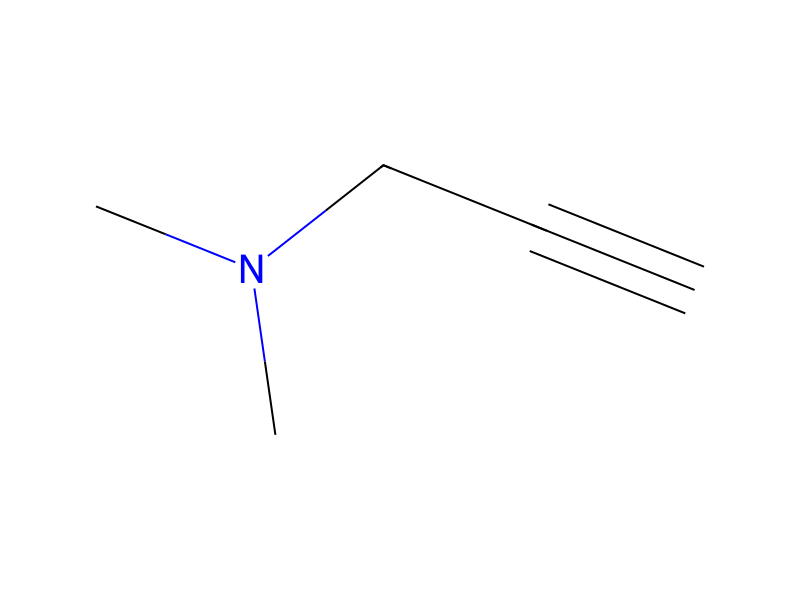
[CH3:1][O:2][C:3](=[O:12])[C:4]1[CH:9]=[CH:8][C:7](Br)=[CH:6][C:5]=1[Cl:11].[CH3:13][N:14]([CH3:18])[CH2:15][C:16]#[CH:17]>C(N(CC)CC)C.Cl[Pd](Cl)([P](C1C=CC=CC=1)(C1C=CC=CC=1)C1C=CC=CC=1)[P](C1C=CC=CC=1)(C1C=CC=CC=1)C1C=CC=CC=1.[Cu]I>[CH3:1][O:2][C:3](=[O:12])[C:4]1[CH:9]=[CH:8][C:7]([C:17]#[C:16][CH2:15][N:14]([CH3:18])[CH3:13])=[CH:6][C:5]=1[Cl:11]Under an atmosphere of nitrogen, a mixture of 4-bromo-2-chlorobenzoic acid methyl ester (25.13 g, 101 mmol), 1-dimethylamino-2-propyne (16 mL, 150 mmol), bis(triphenylphosphine)palladium(II) chloride (1.0 g) and copper (I) iodide (0.15 g) in 100 mL of triethylamine was heated at 60° C. for 2 hours. The cooled reaction mixture was filtered through Solka floc and the cake was washed with ethyl acetate. The filtrate was partitioned between ethyl acetate and dilute aqueous sodium thiosulfate. The organic layer was washed with water, brine and dried over sodium sulfate. The dark solution was filtered through a plug of Merck-60 silica gel and the filtrate was concentrated in vacuo to give the title compound (23.8 g) as an orange oil, which was used as such in the next step.
Wird geladen…