StartseiteMCPWorkbenchSkills
StartseiteWorkbenchBenachrichtigungenMein Bereich
llms.txt · MCP-AnleitungDatenschutz · Nutzungsbedingungen · Supportv1.8.0
  1. Startseite
  2. /Reaktion

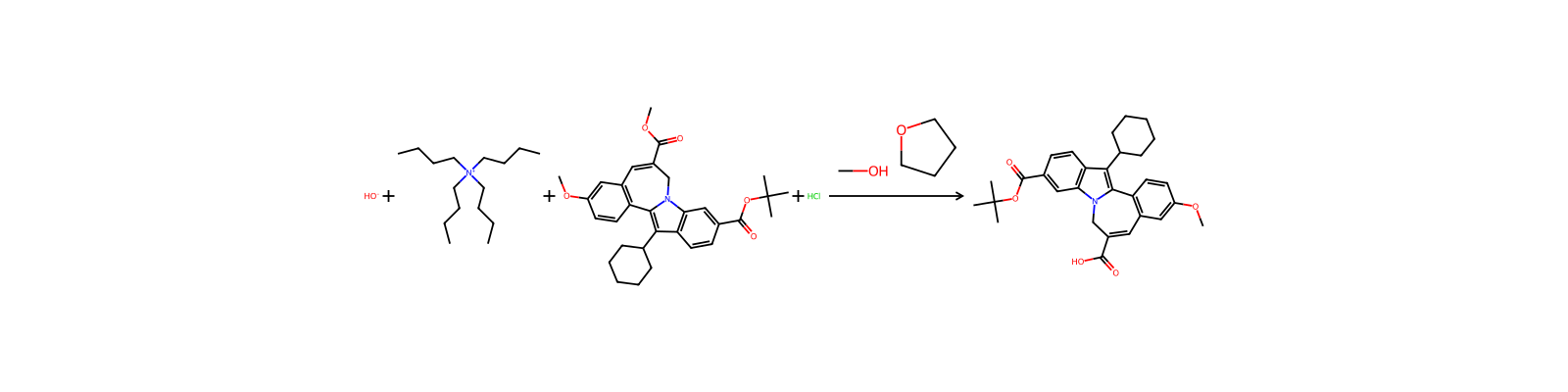
Hydrochloric Acid → 10-(tert-butoxycarbonyl)-13-cyclohexyl-3-methoxy-7H-indolo[2,1-a][2]benzazepine-6-carboxylic acid

HRID 1982926
Notizen
Druckvorschau

Reaktionsgleichung

Reaktionsgleichung von HRID 1982926
[OH-].C([N+](CCCC)(CCCC)CCCC)CCC.[CH:19]1([C:25]2[C:26]3[CH:27]=[CH:28][C:29]([C:49]([O:51][C:52]([CH3:55])([CH3:54])[CH3:53])=[O:50])=[CH:30][C:31]=3[N:32]3[CH2:38][C:37]([C:39]([O:41]C)=[O:40])=[CH:36][C:35]4[CH:43]=[C:44]([O:47][CH3:48])[CH:45]=[CH:46][C:34]=4[C:33]=23)[CH2:24][CH2:23][CH2:22][CH2:21][CH2:20]1.Cl>CO.C1COCC1>[C:52]([O:51][C:49]([C:29]1[CH:28]=[CH:27][C:26]2[C:25]([CH:19]3[CH2:24][CH2:23][CH2:22][CH2:21][CH2:20]3)=[C:33]3[C:34]4[CH:46]=[CH:45][C:44]([O:47][CH3:48])=[CH:43][C:35]=4[CH:36]=[C:37]([C:39]([OH:41])=[O:40])[CH2:38][N:32]3[C:31]=2[CH:30]=1)=[O:50])([CH3:55])([CH3:53])[CH3:54]
KomponentenVersuchsvorschriftAufarbeitungQuellen und NachweiseNotizen zur Reaktion

Komponenten

6

Edukt 3

HCID 313Hydrochloric AcidHCID 2723671Tetrabutylammonium HydroxideHCID 5983755810-tert-butyl 6-methyl 13-cyclohexyl-3-methoxy-7H-indolo[2,1-a][2]benzazepine-6,10-dicarboxylate

Produkt 1

HCID 5771220210-(tert-butoxycarbonyl)-13-cyclohexyl-3-methoxy-7H-indolo[2,1-a][2]benzazepine-6-carboxylic acidAusbeute 118 %

Reagenzien, Katalysatoren, Lösungsmittel 2

HCID 887
Methanol
Lösungsmittel
HCID 8028TetrahydrofuranLösungsmittel

Versuchsvorschrift

Tetrabutylammonium hydroxide (40% in water, 14.4 mL, 22 mmol) was added to a slurry of 10-tert-butyl 6-methyl 13-cyclohexyl-3-methoxy-7H-indolo[2,1-a][2]benzazepine-6,10-dicarboxylate (5.0 g, 10 mmol) in MeOH (40 mL) and THF (40 mL) and the reaction was stirred at rt ON (complete by LCMS). The reaction mixture was neutralized with 1N HCl (aq) (24 mL) and concentrated to remove the organic solvents. The sludge was diluted with water, stirred and the solids were collected by filtration. The wet solids were dissolved into EtOAc (˜250 mL), washed with brine (100 mL), dried (MgSO4), filtered and concentrated to yield 10-(tert-butoxycarbonyl)-13-cyclohexyl-3-methoxy-7H-indolo[2,1-a][2]benzazepine-6-carboxylic acid (5.73 g, 11.8 mmol, 118% yield) as a bright yellow solid. The product appears to be mixed with a tetrabutylammonium by-product. The material was used without further purification. 1HNMR (300 MHz, CDCl3) δ ppm 1.14-2.13 (m, 10H), 1.60 (s, 9H), 2.73-2.86 (m, 1H), 3.89 (s, 3H), 4.03-4.26 (m, 1H), 5.49-5.80 (m, 1H), 6.98 (d, J=2.6 Hz, 1H), 7.07 (dd, J=8.4, 2.6 Hz, 1H), 7.56 (d, J=8.4 Hz, 1H), 7.64 (dd, J=8.4, 1.1 Hz, 1H), 7.79 (d, J=8.4 Hz, 1H), 7.89 (br s, 1H), 8.19 (s, 1H. LC-MS retention time: 4.32 min; 488 m/z (MH +). LC data was recorded on a Shimadzu LC-10AS liquid chromatograph equipped with a Phenomenex-Luna 10u C18 3.0×50 mm column using a SPD-10AV UV-Vis detector at a detector wave length of 220 nM. The elution conditions employed a flow rate of 5 mL/min, a gradient of 100% solvent A/0% solvent B to 0% solvent A/100% solvent B, a gradient time of 4 min, a hold time of 1 min, and an analysis time of 5 min where solvent A was 10% MeOH/90% H2O/0.1% trifluoroacetic acid and solvent B was 10% H2O/90% MeOH/0.1% trifluoroacetic acid. MS data was determined using a Micromass Platform for LC in electrospray mode.

Aufarbeitung

  1. concentrationconcentrated
  2. customto remove the organic solvents
  3. additionThe sludge was diluted with water
  4. stirringstirred
  5. filtrationthe solids were collected by filtration
  6. dissolutionThe wet solids were dissolved into EtOAc (˜250 mL)
  7. washwashed with brine (100 mL)
  8. dry with materialdried (MgSO4)
  9. filtrationfiltered
  10. concentrationconcentrated

Quellen und Nachweise

ORD-Eintrag
ord-e898607eb7ef49ea9ea42e733afda24b
Quelldatensatz
uspto-grants-2009_06
DOI
10.6084/m9.figshare.5104873.v1
Patentnummer
US07541351B2

Notizen zur Reaktion

Wird geladen…

Auf dieser SeiteKomponentenVersuchsvorschriftAufarbeitungQuellen und NachweiseNotizen zur Reaktion

