Reaktionsgleichung

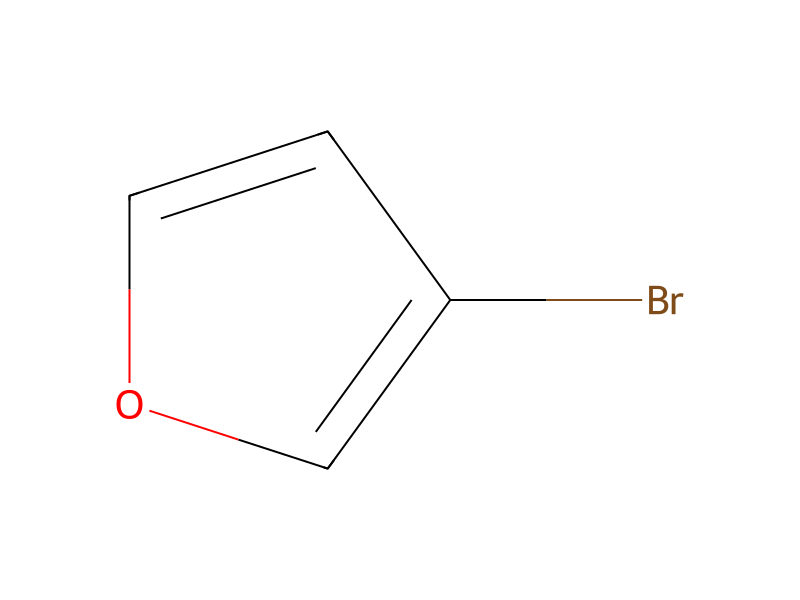
Br[C:2]1[CH:6]=[CH:5][O:4][CH:3]=1.[CH:7]([C:9]1[CH:14]=[CH:13][C:12](B(O)O)=[CH:11][CH:10]=1)=[O:8].C(#N)C.C(=O)([O-])[O-].[Na+].[Na+]>Cl[Pd](Cl)([P](C1C=CC=CC=1)(C1C=CC=CC=1)C1C=CC=CC=1)[P](C1C=CC=CC=1)(C1C=CC=CC=1)C1C=CC=CC=1.C(OCC)(=O)C>[O:4]1[CH:5]=[CH:6][C:2]([C:12]2[CH:13]=[CH:14][C:9]([CH:7]=[O:8])=[CH:10][CH:11]=2)=[CH:3]1Komponenten
7
Edukt 4



Produkt 1

Reagenzien, Katalysatoren, Lösungsmittel 2


Reaktionsbedingungen
- Temperatur
- 150 °C
Versuchsvorschrift
In a microwave vial, 3-bromo-furan (590 mg, 4.02 mmol), 4-formyl phenylboronic acid (600 mg, 4.02 mmol) and 7 ml of actonitrile were mixed. 8 ml of 1N aqueous sodium carbonate was then added to the mixture, followed by 5 mole percent of dichlorobis-(triphenylphosphine)-palladium(II). The reaction vessel was sealed and heated at 150° C. for 7 minutes with microwave irradiation. After cooling, 50 ml of ethyl acetate was added, the organic layer was separated, washed with water, dried over sodium sulfate. The organic solvent was evaporated to give crude product, which was purified by ISCO to give 410 mg of 4-furan-3-yl-benzaldehyde, yield: 60%.
Aufarbeitung
- customThe reaction vessel was sealed
- temperatureAfter cooling
- customthe organic layer was separated
- washwashed with water
- dry with materialdried over sodium sulfate
- customThe organic solvent was evaporated
- customto give crude product, which
- customwas purified by ISCO
Quellen und Nachweise
- ORD-Eintrag
- ord-d40ee465102846e5af7c431188f75c05
- Quelldatensatz
- uspto-grants-2009_06
- Patentnummer
- US07553840B2
Verknüpfte Notizen
Wird geladen…