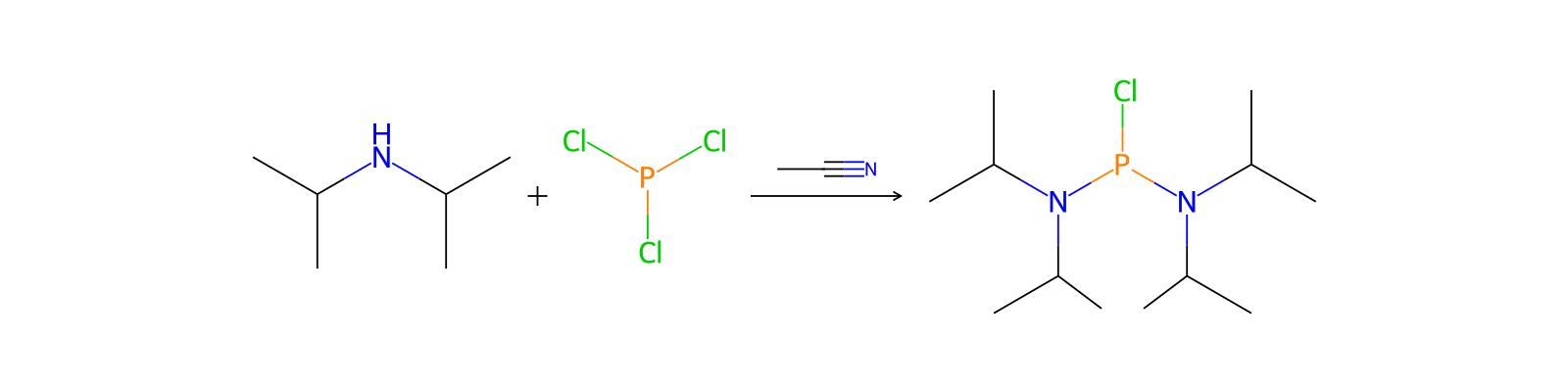
Beteiligte Stoffe
| Rolle | Name | HCID | Einwaage |
|---|
| Edukt | Diisopropylamine | HCID 7912 | — |
| Edukt | Phosphorus trichloride | HCID 24387 | — |
| Lösungsmittel | Acetonitrile | HCID 6342 | — |
| Produkt | Bis(diisopropylamino)chlorophosphine | HCID 2733425 | 74% |
Reaktionsschritte
A 5-liter, 3-neck, round-bottom flask was equipped with a Fredrich's condenser, a ground glass stirrer bearing, a silicon rubber septum, and placed under dry argon. Two liters (1,600 grams, 15.9 mmols, 7.0 eq) of anhydrous diisopropyl amine was added to the flask. The diisopropyl amine was diluted by the addition of two liters of anhydrous acetonitrile. The solution was mixed with a mechanical stirrer attached to a glass stir rod and Teflon blade. An ice/water bath was placed under the 5-liter flask, and the amine solution allowed to cool for 30 min. Phosphorus trichloride (313 grams, 2.3 mmols, 1.0 eq) was dissolved in 1 liter of anhydrous acetonitrile in a separate dry 1-liter flask. The mechanical stirrer was set to vigorous stirring and the phosphorus trichloride solution added slowly to the stirring flask by cannula. Once the addition was complete, the ice/water bath was removed, and the reaction was allowed to warm to room temperature. The reaction was stirred overnight and the extent of the reaction determined by 31P NMR of an aliquot of the reaction mixture using an external lock. Complete conversion of the starting material, phosphorus trichloride (δ 201 ppm), into the product at δ 134 ppm, demonstrated completion of the desired reaction. The reaction mixture was filtered to remove the bulk of the diisopropylamine hydrochloride, which had precipitated. The precipitate was washed with anhydrous ether and the filtrates evaporated into a 2-liter round-bottom flask. The resulting evaporated product was a semi-crystalline solid, which was suspended in 1 liter of anhydrous hexanes. The flask was heated on a mantel, to allow the hexanes to boil. The hot liquid was filtered through a Schlenk filter-funnel to remove residual amine hydrochloride. This resulting clear yellow liquid was evaporated to one half the original volume and placed in a freezer to allow the product to recrystallize. The recrystallized product was isolated by filtration and dried in a vacuum desiccator, yielding 447 grams (74% yield).
Herkunft & Nachweise
| DOI | 10.6084/m9.figshare.5104873.v1 |
|---|
| Patentnummer | US07745591B2 |
|---|
| Quelldatensatz | uspto-grants-2010_06 |
|---|
| ORD ID | ord-4f322ccfbd9c405ba8fc5c8f61b34de0 |
|---|
| Quellennotiz | uspto-grants-2010_06 |
|---|