Picolinoyl Chloride Hydrochloride → HCID 59577127, Verbindung
Reaktionsgleichung

Cl.[C:2]([C:6]1[CH:17]=[CH:16][CH:15]=[CH:14][C:7]=1[O:8][CH:9]1[CH2:13][CH2:12][NH:11][CH2:10]1)([CH3:5])([CH3:4])[CH3:3].Cl.[N:19]1[CH:24]=[CH:23][CH:22]=[CH:21][C:20]=1[C:25](Cl)=[O:26]>N1C=CC=CC=1>[C:2]([C:6]1[CH:17]=[CH:16][CH:15]=[CH:14][C:7]=1[O:8][CH:9]1[CH2:13][CH2:12][N:11]([C:25]([C:20]2[CH:21]=[CH:22][CH:23]=[CH:24][N:19]=2)=[O:26])[CH2:10]1)([CH3:5])([CH3:3])[CH3:4]Komponenten
4
Edukt 2
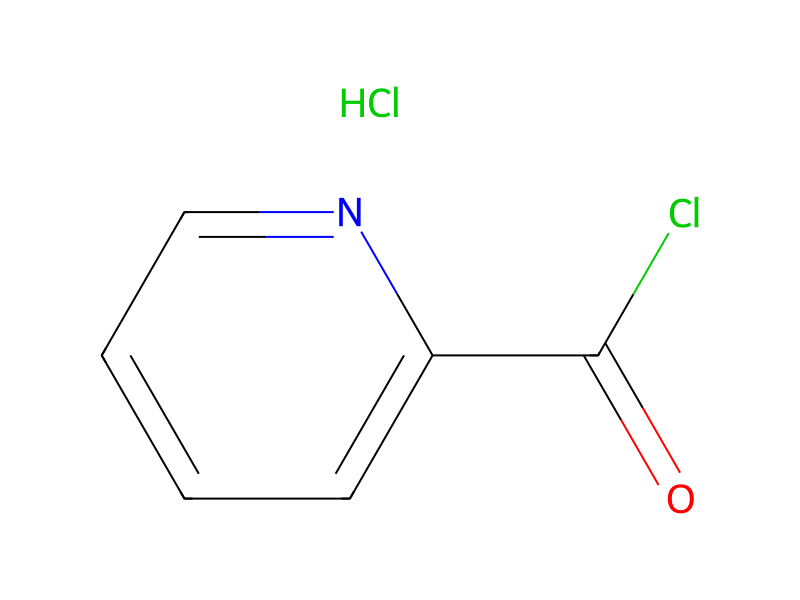

Produkt 1

Reagenzien, Katalysatoren, Lösungsmittel 1

Versuchsvorschrift
To a stirred solution of 3-(2-tert-butylphenoxy)pyrrolidine hydrochloride (0.26 g, 1.00 mmol) in pyridine (2.5 mL) was added picolinoyl chloride hydrochloride (0.20 g, 1.10 mmol) at room temperature. After 16 h the reaction mixture was concentrated under reduced pressure, the residue partitioned between ethyl acetate (50.0 mL) and water (50.0 mL) and separated. The organic layer was washed with saturated sodium chloride (50.0 mL), dried (MgSO4), filtered, and concentrated under reduced pressure. Purification by flash column chromatography (silica gel, 80:20 to 50:50 heptane/ethyl acetate) provided (3-(2-tert-butylphenoxy)pyrrolidin-1-yl)(pyridin-2-yl)methanone (0.14 g, 43%) as a pale yellow oil.
Aufarbeitung
- concentrationAfter 16 h the reaction mixture was concentrated under reduced pressure
- customthe residue partitioned between ethyl acetate (50.0 mL) and water (50.0 mL)
- customseparated
- washThe organic layer was washed with saturated sodium chloride (50.0 mL)
- dry with materialdried (MgSO4)
- filtrationfiltered
- concentrationconcentrated under reduced pressure
- customPurification by flash column chromatography (silica gel, 80:20 to 50:50 heptane/ethyl acetate)
Quellen und Nachweise
- ORD-Eintrag
- ord-83eb8185ef65483aadad863ff41c6b2b
- Quelldatensatz
- uspto-grants-2013_11
- Patentnummer
- US08586571B2
Notizen zur Reaktion
Wird geladen…