StartseiteMCPWorkbenchSkills
StartseiteWorkbenchBenachrichtigungenMein Bereich
llms.txt · MCP-AnleitungDatenschutz · Nutzungsbedingungen · Supportv1.8.3
  1. Startseite
  2. /Reaktion

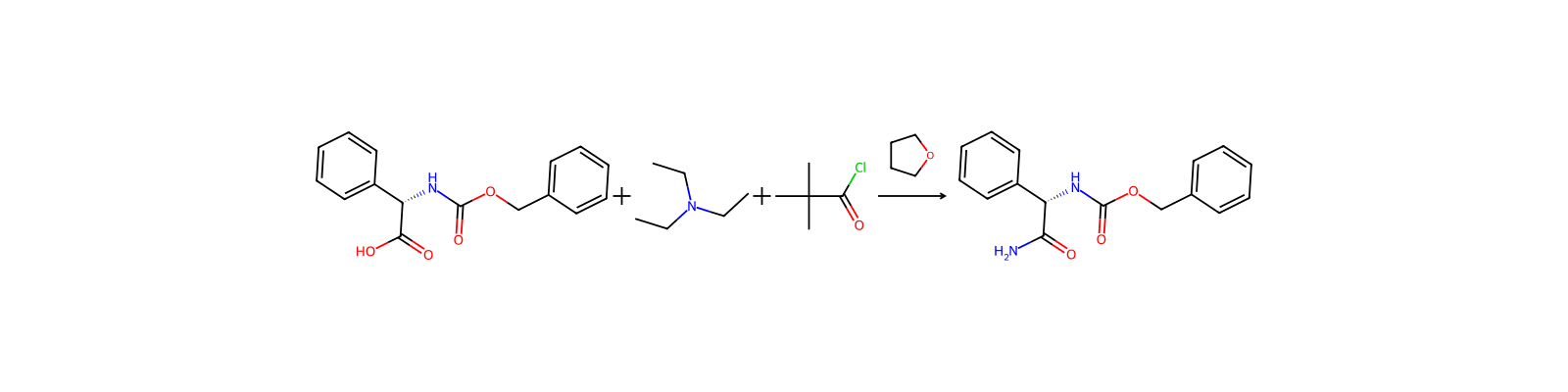
Triethylamine → Z-L-Phg-NH2

HRID 2052268
Drucken

Reaktionsgleichung

Reaktionsgleichung von HRID 2052268
[NH:1]([C:12]([O:14][CH2:15][C:16]1[CH:21]=[CH:20][CH:19]=[CH:18][CH:17]=1)=[O:13])[C@H:2]([C:9](O)=[O:10])[C:3]1[CH:8]=[CH:7][CH:6]=[CH:5][CH:4]=1.C([N:24](CC)CC)C.C(Cl)(=O)C(C)(C)C>O1CCCC1>[NH:1]([C:12]([O:14][CH2:15][C:16]1[CH:21]=[CH:20][CH:19]=[CH:18][CH:17]=1)=[O:13])[C@H:2]([C:9]([NH2:24])=[O:10])[C:3]1[CH:8]=[CH:7][CH:6]=[CH:5][CH:4]=1
KomponentenReaktionsbedingungenVersuchsvorschriftAufarbeitungQuellen und NachweiseNotizen zur Reaktion

Komponenten

5

Edukt 3

HCID 8471TriethylamineHCID 62493Pivaloyl chlorideHCID 819214Z-Phg-OH

Produkt 1

HCID 36690768Z-L-Phg-NH2Ausbeute 68,7 %

Reagenzien, Katalysatoren, Lösungsmittel 1

HCID 8028TetrahydrofuranLösungsmittel

Reaktionsbedingungen

Temperatur
-10 °C

Versuchsvorschrift

27.6 g (97 mmoles) of Z-L-Phg-OH are dissolved in 300 ml of dry tetrahydrofuran, and 13.55 ml (97 mmoles) of triethylamine are added to the solution. The mixture is cooled to -10° C., and 12.1 ml (97 mmoles) of pivaloyl chloride are introduced. The suspension of the mixed anhydride is stirred for 10 minutes at -10° C., thereafter cooling is stopped and ammonia is bubbled through the suspension for one hour. Next day the reaction mixture is evaporated, and the residue is processed as described for the D enantiomer. 18.90 g (68.7%) of Z-L-Phg-NH2 are obtained; m.p.: 172°-173° C., Rf4 =0.75, [α]D =+80.7° (c=1.0, in dimethyl formamide).

Aufarbeitung

  1. temperaturecooling
  2. customammonia is bubbled through the suspension for one hour
  3. customNext day the reaction mixture is evaporated

Quellen und Nachweise

ORD-Eintrag
ord-a6ab6b5dde2c43febb1212f6add3fe4a
Quelldatensatz
uspto-grants-1980_01
DOI
10.6084/m9.figshare.5104873.v1
Patentnummer
US04183909

Notizen zur Reaktion

Auf dieser SeiteKomponentenReaktionsbedingungenVersuchsvorschriftAufarbeitungQuellen und NachweiseNotizen zur Reaktion